When two become one
The Nitroplast and the making of an individual We tend


October 14, 2026 – Italian Translation – From the prevention of the war in Ukraine to the conclusion of the initial intervention
In December 2021 President Putin put on the table draft agreements with NATO and with the United States on security arrangements. At their core was no further NATO enlargement. There were other claims that I do not think NATO should have accepted, or ever would have, but at the core was: stop NATO enlargement. So I called the White House, the Biden White House. These were supposedly my friends, I thought. I talked with Jake Sullivan, the national security adviser, and said, “Jake, take the deal. Take the off-ramp. Avoid a war.” He said, “No, Jeffrey. NATO has an open-door policy. We can’t declare that NATO won’t enlarge.” I said, “Jake, are you kidding? Really? Does Mexico have an open-door policy to host a Chinese base? Does Canada have an open-door policy to host a Russian base in Windsor? What is this open door?” He said, “Oh, Jeffrey, don’t worry. NATO is not going to enlarge to Ukraine.” I said, “Jake, that’s really interesting. Why don’t you just say that publicly?” “Oh, no, we can’t say that publicly, Jeffrey. We have an open-door policy.” So I said, “Jake, you’re going to have a war over something that isn’t even going to happen.” And he said, “Jeff, don’t worry. There’s not going to be a war.” Click.
That is American foreign policy. Honest to God, I cannot even convey the incompetence of it, every sentence incompetent. America has rejected an open door in the Western Hemisphere since 1823. It is called the Monroe Doctrine. There is no open door; the door is closed. But the idea that America cannot put its military bases in Ukraine? That is Putin being a dictator. Come on, ladies and gentlemen. This is what got us into this: that we cannot focus honestly on what was said, what was done, why it was done, what the concerns are, and what has led us here. That is why we are in this war. And to listen to this for four years is really unbelievable.
By the way, I know many of the European leaders, though not all of them, and I know what they have said to me privately over the years and what they say publicly. I know leaders who are today heads of government in Europe who said to me in 2008, “Jeff, what is your president doing, pushing this NATO enlargement?” Now they are public defenders of everything. What is this? That is how we all get killed, if nobody can speak the truth about any of this. This is not propaganda. It is just basic sense and basic history.
So my view is that there is no reason for a war with Russia. There is no reason for a war with China. There is no reason for any of these wars. There is no reason for a genocide in Gaza, for God’s sake. That is the United States and Israel complicit in a genocide, because the United States vetoes the State of Palestine. That is all that this is, and it has its own history. Mr. Netanyahu’s party has said since 1977 that all the land from the Jordan River to the Mediterranean Sea will be under Israeli sovereignty. So the slogan that gets my students arrested right now, “from the river to the sea,” is Netanyahu’s slogan, by the way. It is the Likud slogan, not the Palestinian slogan.
There is no reason for any of these wars. And by the way, apart from Pedro Sánchez, I did not hear Europe utter a murmur about America’s attack on Iran. I may have missed some leaders, but I do not think I missed many. That attack was a brazen, murderous violation of every single international standard we have. Trump brags that his six predecessors would not do it. Yes, you are the only one stupid enough to do it. But where is Europe?
Let me tell you a little story about where Europe is on Iran, and then I will stop. On the day of the attack, I was asked by the Chinese, Russian and Iranian missions to the UN whether I would say something in the UN Security Council, because I believe in peace and I do not believe in murdering another country’s leadership. I think it is a bad idea, especially when you are in the middle of negotiations. That is why the Iranian leaders were all assembled at the Supreme Leader’s residence: to discuss what their negotiating position would be in Vienna early the following week. And Mossad, which is so clever, said, they are all going to be meeting, so why don’t we kill them all? A very intelligent Israeli policy, I may add. And Trump, being the fool that he is, said, yes, that is a great idea: I kidnapped the president of Venezuela and now I have all their oil revenues, so let’s do the same with Iran, and I will choose the next leader the next day. He literally thought that.
In any event, they attacked, the Security Council met that afternoon, and I was asked to testify. So I went to the Security Council chamber. The British were in the chair, and they ruled me out of order: there would be no witnesses, and Mr. Sachs had no role in the discussion. That is Britain. I have come to understand Britain well over the last 50 years, and they still believe they are the British Empire, just to let you know, if there is any doubt.
So I sat there, in growing and absolute shock, because every European ambassador started with a criticism of Iran for attacking its neighbors. You cannot make this up. It happened that Bahrain was the first to speak. You know that Bahrain hosts the American fleet in the Persian Gulf, and so when Iran was attacked that day, it struck back at the American fleet. Literally, and I am quoting now, though I may get a word wrong, the Bahraini ambassador opened the meeting by saying, “We are meeting here today to condemn the unprovoked attack by Iran on Bahrain.” I thought, that’s a little odd, “unprovoked.” But the whole session went on this way: the French ambassador, the British ambassador, the Greek ambassador, some with glimpses of humanity, most without. It was all Iran, Iran the criminal state. Nobody in Europe said that the United States should not have started a war against Iran.
So, honestly, I love Europe, but not this political leadership right now. I do not understand it. Europe used to have a voice, even with its dependence on the United States. There were leaders here who made a difference: Willy Brandt, Helmut Schmidt, Helmut Kohl, Gerhard Schröder, and I would say Angela Merkel up to the first day of the Bucharest NATO summit. And Mitterrand; you can go on and on down the list. These were real people. They thought, they discussed, they debated, and they stood up for Europe’s post-World War II values. Those have not always been Europe’s values, but they were the values that were learned and raised up after World War II, drawing on the best of Western civilization, I might add. So they were Western values, just not the ones that had always been deployed. These were impressive people who spoke out, who opposed the Iraq war, who stood up for Ostpolitik, who advised against this or that, who wanted the Helsinki Final Act, the OSCE and indivisible security.
That is the Europe I really want. I know it is there. I think it is the overwhelming wish of the European public, which is why it does not surprise me that you will soon need a microscope to find President Macron’s approval rating. I do not think it can technically go negative, but it will be near zero, and hundreds of thousands of young people on the streets of France are signifying that. And Merz must be the least successful and least approved chancellor in modern German history, because he is a warmonger. Why he is a warmonger I cannot understand. He should pick up the phone, call his counterpart in Moscow and say, “President Putin, it’s time that we talked.” That should have been the first thing he did on his first day in office. Maybe it would have been disappointing, but he would have tried. He never tried.
That is the Europe we need. I am an outsider, but I love Europe, so I do not want you to give up on it. I do not think it takes years of change. It takes a change of understanding and of heart. I would recommend doing it tomorrow, before Ukraine freezes this winter, so that the suffering stops. Europe is not standing up for Ukraine. Europe is killing Ukraine. People are going to die in mass numbers; there will not be safe water. Russia is fighting the war to win right now because every day Europe says that it is fighting the war to win, too. This kind of rhetoric is complete madness in the nuclear age, and madness given what the stakes are.
And, to finish, this is not about a ceasefire. This is about a European politician standing up and saying, “Mr. Putin, NATO will not enlarge to Ukraine or to Georgia. Now let’s stop the war.” That is what this is about, and the war will stop on that basis. There will be disagreements about the borders, because we will not have a juridical settlement of the borders. We will have an armistice line and a line of administrative control, as in a lot of places in this world, and that could last for years or even decades. But the fighting will stop, the madness will stop, and the march to nuclear war will stop. That requires not saying every day that we must have a ceasefire, but rather that we must have peace and indivisible security. And that is easy to accomplish, because the reason for this war is absolutely clear. Thanks a lot.
Fidias Panayiotou: We gave you fifteen minutes, or ten, and you took an hour, but it was amazing. Thank you. It was really interesting and really inspiring. I will ask one or two questions, and then we will move quickly to some very brief questions from the floor. This house is gearing up, and Europe is gearing up. There is a lot of money going into building weapons. We are 450 million people in Europe, and Russia is about 140 million. I am not saying that we support this, but what do you think will happen? Do you think that we as Europe will be able to keep the fighting going, and to counterbalance Russia? Because right now Russia is winning. Diplomacy is surely the way, but please share what you think will happen now.
Jeffrey Sachs: I think Ukraine will be destroyed before any European weapons even come off a production line, and even if they did, they would not stop anything. You are confronting a nuclear superpower. Using the language of “we must defeat Russia” or “Russia must lose” toward a nuclear superpower is a mind-boggling error. It is a category error, an error of judgment, and an error that could get everybody killed.
There is a famous line in a speech by President Kennedy, and let me give you the context. In the Cuban missile crisis of October 1962, as I think everybody knows, we came close to nuclear Armageddon. If you do not know the history, read Gambling with Armageddon by Martin Sherwin, the greatest American historian of the atomic age. It is the definitive account of the Cuban missile crisis, and more fascinating than you can imagine. Sherwin describes how we came within a second of a nuclear attack by a disabled Soviet submarine with a nuclear-tipped torpedo, which under American doctrine would have led to a full nuclear counterstrike by the United States that would probably have ended civilization. Kennedy found his way out of that mess, and Khrushchev found his way out too. They were both great men, by the way, because all their advisers said, go to war, and Kennedy and Khrushchev said, that is not a good idea, let’s find a way out of this. They did, and we survived to tell about it.
In the following year, Kennedy was determined to pull the world back from the brink of nuclear war, and that is where the Partial Nuclear Test Ban Treaty came from. I wrote a book about this episode called To Move the World: JFK’s Quest for Peace. It is a short book and a quick read, about a famous speech that Kennedy gave on 10 June 1963, in which he told the American people that we needed to make peace with the other side. He did not make demands of the Soviet Union. He told the American people: let us think, because otherwise we are all going to die. When Khrushchev read the speech, he said that he wanted to make peace, because Kennedy did not say, you do this, you do that, you are evil. Kennedy said that we need to rethink our own attitude so that we can make peace. And Khrushchev said, all right, we too. And peace began. What Kennedy showed brilliantly was respect. It was more than a little respect; it was the most eloquent speech.
In it he says the following: “Above all, while defending our own vital interests, nuclear powers must avert those confrontations which bring an adversary to a choice of either a humiliating retreat or a nuclear war. To adopt that kind of course in the nuclear age would be evidence only of the bankruptcy of our policy, or of a collective death-wish for the world.”
Let me explain why this is so important. After the missile crisis, in a speech filled with important points, Kennedy says “above all,” and he means it. Above all, what? Do not put a nuclear power to the choice of either a humiliating retreat or a nuclear war. Well, Madame Kallas wants to humiliate Russia every single day. The Baltic states want to humiliate Russia every single day. Mr. Sikorski wants to humiliate Russia every single day. I am happy to name names, because I have worked with all of their governments. I hold the top award of the Estonian government for my service to that country, and the top award of the Polish government for my service to that country. I am no enemy of their countries. I helped them at crucial moments.
Stop trying to humiliate Russia. Stop trying to force Russia into a “humiliating defeat.” Above all, avoid that, because that is a death wish. Do you really want the death wish? Do you want some stupid American general saying that we could take Kaliningrad, no problem, and then, when Putin says that Russia will use all means to defend it, all these stupid pundits saying, “Oh, he’s just bluffing”? I am so sick of these pundits. What are these people going to do after the nuclear war? “Oh, I’m sorry, he wasn’t bluffing”? Is the idea really humiliation, when the person who lived through this more than any other person in history is telling you to avoid forcing a humiliating retreat?
So what is this arming to go to war with Russia? They have 1,600 actively deployed nuclear weapons. Are you kidding? What are you thinking? Sit down and talk honestly, and stop wasting your money on all of this. Look at the PISA scores that came out last month. Europe did not do well, and that is part of why the students in Paris are out on the streets. They are not getting a decent education right now. It is a shame. Britain cannot keep its health service running. Do we really want World War III at this moment, when governments can barely stave off fiscal insolvency? No, it is not a good idea. It is much cheaper to make a phone call. A phone call does not cost 450 billion euros or 900 billion euros. I have even offered my own Zoom account: if President Costa wants to use it, or Chancellor Merz wants to use it, I will pay the bill. Make a phone call. Meet Lavrov. I have known him for 30 years. He is incredibly smart. Talk with him. Review the history. Talk about what could be done. There will be some things that are unacceptable, but there will be many things that are absolutely correct, too. That is when you have diplomacy.
So no, it is not a good idea to build up these armaments, because Russia does not have the slightest interest in marching into Europe. It never did, except when Napoleon bothered it and when Hitler bothered it. Just leave a little space for Russia, and Russia will leave a little space for you. My proposal is that Ukraine should be neutral. That works for your security, it works for Russia’s security, and it works for Ukraine’s security, just as it did for Austria. What a wonderful arrangement Austria made in 1955. It escaped the Cold War division by declaring neutrality.
By the way, had Germany accepted neutrality in 1952, as Stalin proposed, the Cold War could have ended in 1952. Adenauer turned it down, because he said that he would rather have a divided Germany, with West Germany anchored with the United States, than a unified neutral Germany. When the German historian Rolf Steininger studied this question, he uncovered a document in the British archives, a record of what Adenauer had conveyed to a senior Foreign Office official, in which Adenauer said, in effect: I do not oppose unification and neutrality because I distrust Stalin; I oppose it because I distrust the German people. Incredible. But he never said that publicly. So he turned down the chance to end the Cold War in 1952. If we want to end the hot war right now, Ukraine should be neutral. Period.
Fidias Panayiotou: Thank you for the passion that you bring here, because a lot of people are dying. This is very, very serious. I also want to thank you because, when we recorded a podcast earlier, I raised the problem we have in Cyprus, which is occupied by Turkey, and you offered to do the same thing that you are offering now: because you are friends with Erdoğan, to sit down with the president of Cyprus and with Erdoğan, so that hopefully we can solve the problem by talking. Now, I am sure you all have some questions. Danilo, feel free to jump in. Let’s start with Slovakia.
Member of the European Parliament (Slovakia): Dear Professor, you are a true legend in Slovakia, because a few years ago you were in a television discussion with a moderator, as you may remember, and she was fired because you told the truth about Russia and Ukraine. Thank you for coming, and thank you for an excellent lecture. As you said, the old world order is collapsing. This world order was based on American hegemony, and now there may be a new world order replacing the old one. Can you imagine this new world order based on an equilibrium, a balance between the United States on one side and the BRICS countries, including China, Russia and others, on the other? And what should be the role of the European Union in this arrangement? For now we are just puppets of the United States, very dependent on it in energy, economically, politically and militarily, and that is not good for us, as you said. And one small question: the West betrayed the Russians in the 1990s. If you, as an adviser to Gorbachev, had a time machine and could go back, what would you have advised Gorbachev and others to do differently, knowing that they would be betrayed?
Jeffrey Sachs: I believe in a world of regions, because in our world today no country, not Slovakia, not Germany, not France, not the United States, not China, is big enough on its own to build a decarbonized energy system, to save the physical environment, or to handle the many challenges of AI and the other things we are going to face. So I believe in a strong Europe, and I believe in other regions of the world as well. I used to tell other regions to emulate the European Union and make a union. I have counseled African countries for decades to strengthen the African Union. I work with ASEAN to strengthen the countries of Southeast Asia as a union, and so on.
What does that mean for the world order? I say that right now there are four superpowers: the United States, Russia, China and India. Europe is, of course, a superpower in economic terms and in terms of quality of life, but not in geopolitical terms, because there is no European geopolitics right now. There should be a European geopolitics that reflects Europe’s interests, but interests in peace, not interests in a coming war with Russia, as I have emphasized.
I believe not in blocs but in a concert. Europe’s finest period of peace was the nineteenth century. It was not perfect, but it was the Concert of Europe. After 1815 and Napoleon’s defeat, first four powers, Austria, Prussia, Britain and Russia, soon joined by Bourbon France, made a five-power Concert of Europe. They had different interests, different politics and different systems, but they said: we will consult each other regularly to avoid war in Europe. It worked very well for some decades, even with a lot of strains, such as the Greek War of Independence, Serbia and the upheavals of 1848. Europe avoided a general war. The wars of German unification and Italian unification and the Crimean War were major wars, but they were not Europe-wide wars. Even after 1871 the concert was still effective. By the 1870s and 1880s it was really being managed by Bismarck, an extraordinarily shrewd and effective chancellor who actually wanted peace. He wanted German unification, and that meant wars, but then he wanted peace in Europe.
The concert began to break down in 1890, when Kaiser Wilhelm II dismissed Bismarck. Germany and Russia had a secret agreement, which Bismarck had negotiated with the Romanovs, that each would remain neutral if the other were attacked by a third country. This was the Reinsurance Treaty, and after Bismarck was thrown out it was allowed to lapse. Russia then signed an alliance with France, and in 1907 Britain joined, creating the Triple Entente, which was opposed by the Triple Alliance of Germany, Austria-Hungary and Italy. So by 1907 Europe was no longer a concert. It was divided into two blocs, and when the Archduke was assassinated in Sarajevo on 28 June 1914, those two blocs ended up, step by step, in the giant clash of World War I.
I am against blocs. I am against the idea of the world divided in two; I think it is a terrible idea. I do not even like alliances at all. I would dissolve NATO. I would say that Europe is not an ally of the United States. Europe and the United States have interests, and we have a shared heritage and a shared culture, but we are not allies. I do not like alliances. What I like is law. I like the UN Charter. I like the idea of all countries abiding by shared principles, and for the great powers, I like the idea of a concert of powers.
That was Franklin Roosevelt’s idea in 1945. He called it the Four Policemen. His idea was that the UN would have four policemen: Britain, the Soviet Union, China and the United States. De Gaulle, an absolutely clever and successful politician, elbowed his way in to make France the fifth policeman. But the idea was that this would be a concert of great powers. Roosevelt was really a great man, by the way. He had a stunningly smart personality and was extraordinarily effective, and one of the things he was effective at was holding the anti-Hitler alliance together with Joseph Stalin. Churchill could not have done it; Churchill was not clever in that way at all. Roosevelt was, and everyone attacks him for it, saying that he sidled up to Joe Stalin and so forth. But Roosevelt was a lot smarter than that. He was determined that we should cooperate rather than go to war.
As I often say, if there had been antihypertensive medicines in 1945, we would never have had a Cold War. Roosevelt died at age 63, a young man, but he had very high blood pressure, and he dropped dead on 12 April 1945. Then everyone told Truman that we were heading for a confrontation with the Soviet Union. And, as everyone knows, within days of Germany’s surrender on 8 May, Churchill asked his own war planners to examine an invasion of the Soviet Union: Operation Unthinkable. That was not Roosevelt’s idea. Roosevelt’s idea was that four powers with very different forms of governance could actually cooperate. The Security Council was to be a concert of powers, not a chamber of showmanship and confrontation. The original idea of the veto was not what we think today, a way to stop the communists or to make sure the other side could not do something terrible. The idea of the veto was to make sure that all the great powers acted in concert together.
I want the United States, India, China and Russia to cooperate. I do not want a bloc. I do not see any reason to oppose China. China just wants normal. It wants a decent life, and it wants not to be surrounded by U.S. military bases. We have an insane doctrine, by the way, from one of our worst secretaries of state ever, John Foster Dulles. You should know that Churchill summed him up as “Dull, Duller, Dulles,” which is a pretty good summary. In 1951 Dulles said, in effect, that we need to keep China away from the open ocean. Can you imagine? It is American doctrine that China should not have access to the Pacific Ocean. It is called the First Island Chain. This is insane. How many wars do we need in this world? China cannot have access to the Pacific Ocean, because America’s boundary is Japan. That is where our boundary is, apparently.
So I do not want a bloc against China. There is a terrible article in the current issue of Foreign Affairs by Kurt Campbell and Rush Doshi arguing that we need to expand our alliance and our bloc so that we can counterbalance China. I wrote a response saying that this is exactly the logic that got us into World War I, and that it is not the way out. Unfortunately, Foreign Affairs will not publish it, so you will not see it there. I am going to try some other way to express the idea. But no, let’s not have a bloc.
What does this mean for Europe? The paradox is that European institutions are losing popularity and support dramatically because of, I think, bad decisions. But it is a terrible mistake to think that somehow more nationalism is going to solve things in Europe. That is not the point. Better decisions would solve things for Europe. The problem in Europe is not Europe-wide institutions; the problem is bad choices. If you fragment, it is going to be much worse, because you need scale. You actually need some champions. Airbus was a very good idea. You need responses in AI and in other areas as well, so that you are not completely dependent on the United States for everything. So I am for a strong Europe as part of this concert of powers, and I would like Europeans to champion Europe, but not a Europe that is going to war. That will get everyone killed, and it is not something to champion. Champion the right things. Europe was the greatest exponent of sustainable development, of quality of life, of peaceful institutions, of unity among the constituent states of a region, of the European Green Deal, and of many absolutely wonderful pioneering things that had the whole world looking to Europe. That is great-power status. That is doing the right thing. Being part of Mr. Trump’s delusional world is not the right thing.
Danilo Della Valle, MEP: As Fidias also said, the EU sometimes uses the magic words “strategic autonomy” to justify rearmament or other geopolitical choices. But it seems that the EU often serves the interests of the United States, as with the resolutions on China or on Russia and Ukraine. How would you define the EU today, in a few words? And another question: could the Global South take actions to prevent the scenario you have outlined, and to restore international law and the United Nations?
Jeffrey Sachs: Great. Wonderful.
The biggest mistake of the European Union as an institution is that it has treated NATO and Europe as the same thing. Juridically that is true in a lot of ways, and you could explain it better than I can, but Europe and NATO are linked as if they were the same. Of course they are not the same, but they are so closely intertwined that this is the very opposite of strategic autonomy. It is a little sad that both institutions are in the same city, this city. If NATO were somewhere else, it would be much better for Europe.
Personally, as Europe’s friend, I would end NATO. I do not think it serves any purpose, and I do not think it protects you at all. I think ending it would clarify thinking. I would end NATO, period. Of course, I would pursue diplomacy alongside it, and I would check out a few things first. But I would end NATO, and Europe needs a modest but real defense, no question. That raises very sensitive issues, especially the nuclear weapons issue, which has to be faced; it is a real issue. But Europe does not need a thousand nuclear weapons, and Europe is not vulnerable to attack unless it provokes a war. So do not talk about taking Kaliningrad in an hour. Do not provoke Russia. Tell your friends in Estonia: you are small, calm down, do not be nasty, there is no reason for it. Then you can start to have strategic autonomy in terms of Europe’s interests.
Europe and Russia are natural trading partners. Russia has 17 million square kilometers and about 145 million people, and it is filled with natural resources. Europe, and Western Europe especially, is a very crowded place, one of the most densely settled regions in the whole world. Economic theory says that one side trades land-based resources and the other trades goods intensive in high skills, and that this is a great exchange, mutually beneficial for both sides. That is not just a theory. That is what happened between 1990 and around 2010, or even around 2020. Nord Stream was a great pipeline for Europe. Of course, I would have liked it to be phased out over time, because I want fossil fuels to end anyway. But the idea that Russia and Europe are natural trading partners is absolutely right.
Europe has inflicted a huge economic disaster on itself with these twenty rounds of sanctions. They have not really hurt Russia, but they have really hurt Europe. You cut yourself off from a principal trading partner, which is a very destructive thing to do, and you can see the European economy spiraling downward because of it. Germany will survive with its factories in China, but what kind of factories will there be in Germany? We will see, but a lot fewer than before, because high-priced U.S. LNG is not going to make for a competitive German industry. And so much of Central Europe depends on the German economy that everybody falls down with it. As for Keynesian militarism, the idea that you are going to get a better quality of life by building a lot of missiles: no, thank you. Quality of life does not come from building missiles. Quality of life comes from having a civilian economy that can deliver what the people of Europe want.
So the problem is the following. Europe cut itself off from Russia. Russia is not suffering, because Russia said: all right, we have another partner, a large, densely populated economy that functions for us as a trading partner the same way that Europe did. It is called China. That is not a marriage of convenience; it is an absolutely sensible economic partnership. It is a great thing for China, which is so crowded and now has access to an extra 17 million square kilometers of natural resources. And Russia needs humanoid robots, because it has a declining population in a vast land area. So China’s robots are going to be mining Russia’s resources and farming Russia’s vast regions. It is a great partnership, and Russia is going to be a very successful country and economy in the future.
Europe should trade, as it always has. But with whom does Europe trade now? It cannot trade with China. It cannot trade with Russia. The United States does not want to trade with you. This is all self-defeating. There is no economic strategy here. My basic view is that the Eurasian landmass, the supercontinent, is home to about 70 percent of the world’s population and should be the center of the world economy. It is a great place for Europe at one end and for China at the other. The two should be connected, everything in between should prosper through this interconnectivity, and it should be one peaceful, integrated supercontinent. That is an economic strategy. I do not know what Europe’s economic strategy is right now. It does not want to trade with anybody, and it is becoming more and more protectionist. Donald Trump, as I say, wants to sell you liquefied natural gas, because the gas producers pay his campaign bills, and you buy it. I would repair the pipeline and re-establish economic relations with Russia.
Member of the European Parliament (Czech Republic): Thank you very much, Professor, for the lecture, and also for your lecture in Slovakia, because in Slovakia now only 30 or 40 percent of people believe that the Ukraine war was started by Russia, whereas 17 percent believe it was Ukraine and 34 percent believe it was the West. That is according to GLOBSEC, and they have to be truthful, because they are not paid by the other side. I wanted to ask: what makes us all think that the West, meaning even the United States and the EU combined, would be a dominant, or even a significant, force in the future? We are basically the size of ASEAN in population. We speak about the conflict between the United States and Russia, but one has 340 million people and the other about 140 million, while the other billions of people watch with vague interest. Won’t this resolve itself, because it will become irrelevant compared with the real economic forces of the big countries of the world?
Jeffrey Sachs: This also relates to what Danilo was asking me, which I forgot to address: the so-called Global South. I do not like the term, by the way, because almost all of the Global South is in the Northern Hemisphere, and I like geography. The term I use is “emerging market and developing countries,” or EMDCs. Interestingly, the EMDCs are 85 percent of the world population, which is a lot, and right now about 60 percent of world output.
So here are some basic facts. I will not have them precisely right, but roughly speaking, in 1950 the European Union-27 and the United States each had about a quarter of world output, so that together they had about half of world output. China had a few percent. Today the United States is about 14 percent of world output and the EU-27 about 13 percent, so instead of 50 percent it is 27 percent. In population, if I remember correctly, the United States and Europe were about 20 percent of the world in 1950, with half of world output, so their per capita income was two and a half times the world average. Today the combined population of the EU and the United States is about 800 million, or 10 percent of the world population. By 2100 both shares will shrink much further. The combined share of the United States and Europe in world output will be perhaps 11 percent, and in world population the United States will be about 4 percent and Europe about 3.4 percent, so roughly 7.5 percent of the world population together.
So the idea of the Western-led world was an interesting phenomenon for two centuries, and I will not review its balance sheet again, but it is not going to happen again. To be clear, China is not going to replace it as the world hegemon either, for a simple arithmetic reason: China’s population is going to decline dramatically. China is going to age. Toward the end of the century its median age will approach 60, and its population will be well under a billion people. On the UN’s medium-fertility projection it will be about 630 million people in a world of 10 billion. So China goes from about 17 percent of the world population today to about 6 percent. Think about what that means for China’s likely share of world output. It peaks around now, at around 20 percent of world output, and then, because of the population decline, it starts to fall. China is not a world hegemon. China is a very successful country, a remarkably peaceful country, and an aging country.
The region with the most dramatic population trends is of course Africa, the only region of the world with very sharp growth ahead. India has a fertility rate near replacement, a little above, so it is projected to peak at about 1.7 billion in the early 2060s and then decline gradually, to about 1.5 billion by 2100. By the end of the century India could be more than twice the size of China. Africa is likely to double in population and could do more than that. Africa was about 9 percent of the world population in 1950, and today it is about 19 percent. It went from around 230 million people to 1.5 billion people today. By 2050 Africa will have about 2.5 billion people, and according to the UN medium scenario, about 3.8 billion by 2100.
By the way, for Europe’s sake, but of course much more for Africa’s sake, the single most strategic thing by far for Africa is to get those children into school now. They are not in school, and no one gives a damn, I can tell you. No one at the IMF, no one at the World Bank, no one anywhere really cares. I am not saying that people do not wring their hands, but no one really cares in the sense of saying, “Oh my God, we have hundreds of millions of children who are going to grow up without an education. What is going to happen?” No one is asking that, not here, not in this house, not in your European External Action Service. It is amazing to me what does not get asked.
So all of this is to say that the West, and let us hope we do not blow ourselves up in the interim, will not run the world. It does not run the world now. The United States obviously cannot defeat Iran. It probably cannot defeat Yemen. And you cannot defeat Russia. We are just in a different kind of world, and the best thing would be to say: we are all stuck in this world together, so what are we going to do? That would be far better than demanding “Western values” and the “rules-based order,” which is farcical. The rules-based order is the United Nations, the very one that the United States has walked out of. There is no U.S.-based or Western-based order, period. There is a UN-based order. We should defend it, make it work, and have a concert of nations that says we are all in this together, and then figure out what we are going to do about some very, very serious problems.
Having said all that, what does it mean for Europe? Nothing bad. There is nothing bad about being 4 percent or 8 percent or 12 percent of the world population. The question is the quality of life that we have. Are we living in peace? Are we living with education, with culture, with decency, with real values? Are we able to feed ourselves reliably? Can we enjoy the wonderful civilization that has been created here? Those are the real issues.
When I got into this line of work many decades ago, even before there were spreadsheets, I could have told you that our share of the world would go down. That seemed quite natural to me; the last 200 years were something that was not going to repeat in the same way. And I always thought about what the United States should do with its power. I said to myself in the 1990s that it should use its power now to build the kind of world we want to live in by the time the United States is no longer so powerful. We never got around to that, because we got the idea instead that we were going to rule the world forever, for as far as the eye can see. Now we are playing out this game with a comic-book president, though that is unfair to comic books, and a very dangerous one because of how completely incapable he is of understanding anything. So we are losing time. What we should be doing, while we still have the relative weight, is helping to build the world that we want to live in in the future. We have a lot of say right now.
Europe has the highest living standards in the world, and it has the highest evaluations of quality of life in the world. I help produce the World Happiness Report each year, and helped get it started, and European countries make up almost the whole of the top twenty. That is quality of life. Teach the rest of the world how to have a good quality of life. That does not mean going to war with Russia; it means quite the opposite. That is a great vocation, and everyone wants to come here. We are staying in Rome this month, and it is packed with people from the rest of the world pouring in to enjoy the food, the history, the beauty, the climate, the concerts and everything else, because the quality of life is very, very high. That can be kept and even enhanced, but not the way we are going right now, and not by breaking relations with China, breaking relations with Russia, and so forth.
Just one more point, though I think I have been absolutely clear. Maybe in three weeks the clouds will break a little in the United States. I hope we have an election, that it is peaceful, and that the votes are honestly counted. Nothing can be taken for granted anymore, but I think that is likely. If it happens, Trump will lose at least one house of Congress, and that will make a very big difference. It will be a dangerous period, because Trump will become even more erratic and more hostile to our constitutional norms and institutions, but it will weaken him very significantly in terms of actual power. That is something to keep in mind.
But what I want to say is that the United States is going to be in a political crisis for the next ten to fifteen years. This is not just a Trump phenomenon that we will get past. We are so confused, as confused as you are. We do not have a coherent discussion of anything in the United States right now. So do not count on things returning to “Western normal.” That is over. Europe needs to find its own way now. You do not need to make an enemy of the United States, but this transatlantic alliance and this NATO business are not your interests. Your interests are with China, with India, with Russia and with Africa, and that is different. And do not depend on the United States for your diplomacy. If a European leader says one more time, “You need to let us at the table; you can’t negotiate without us,” ladies and gentlemen, there is no table. Just call Mr. Lavrov and say that you would like to talk. The United States cannot stop that. That is what you should do, and you do not need the United States for it. In fact, I will not give you an hour on Mr. Kushner and Mr. Witkoff, but this has nothing to do with diplomacy. So make your own diplomacy, please.
Fidias Panayiotou: We are running out of time, so I want to make one or two points, because you brought up Africa and education in Africa. One thing I did in the past was at an orphanage in Burundi, the poorest country in the world. We equipped it with about 20 computers and an internet connection, powered by solar panels, and now hundreds of children there have access to the internet. I did this personally, with my own money and with a GoFundMe, and if anyone watching is interested in opening more projects like that, they can write to me at my email as a Member of the European Parliament, to kick-start more of them. And one more thing about education: I think education is one of the most important things that we should look at in Europe. Our educational systems mostly fail. I will speak for my country, Cyprus. The children are suffering. They are growing up in a new era with phones, they are getting so much information from the internet and elsewhere, and then they go to school and it feels like a prison. So we need to step up and improve the educational system a lot.
Jeffrey Sachs: How interesting. Look at the PISA study that the OECD released last month. It is very interesting. Number one in the world rankings in mathematics and science is China, though of course not all of China: Beijing, Shanghai, Jiangsu and Zhejiang, four regions, number one by far. All of the top rankings are in East Asia. That is not a matter of income or GDP level; that is education, measured by objective examinations of reading, science and mathematics. Europe is in the second tier, much lower. And then, of course, there is disaster, because PISA does not include almost any of Africa. African countries are not even at the bottom of the list.
Fidias Panayiotou: Exactly. So we have a lot of very practical, basic things to do. As you say, this should be a no-brainer. How did you enjoy your time here in the European Parliament, Jeffrey?
Jeffrey Sachs: I hope that I still get invited back sometime in the future, but I love being here. Thank you, Danilo. Thank you, and thank you all for being here.
Fidias Panayiotou: Thank you for spending your time with us. Good night.
The Nitroplast and the making of an individual We tend
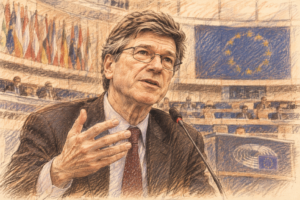
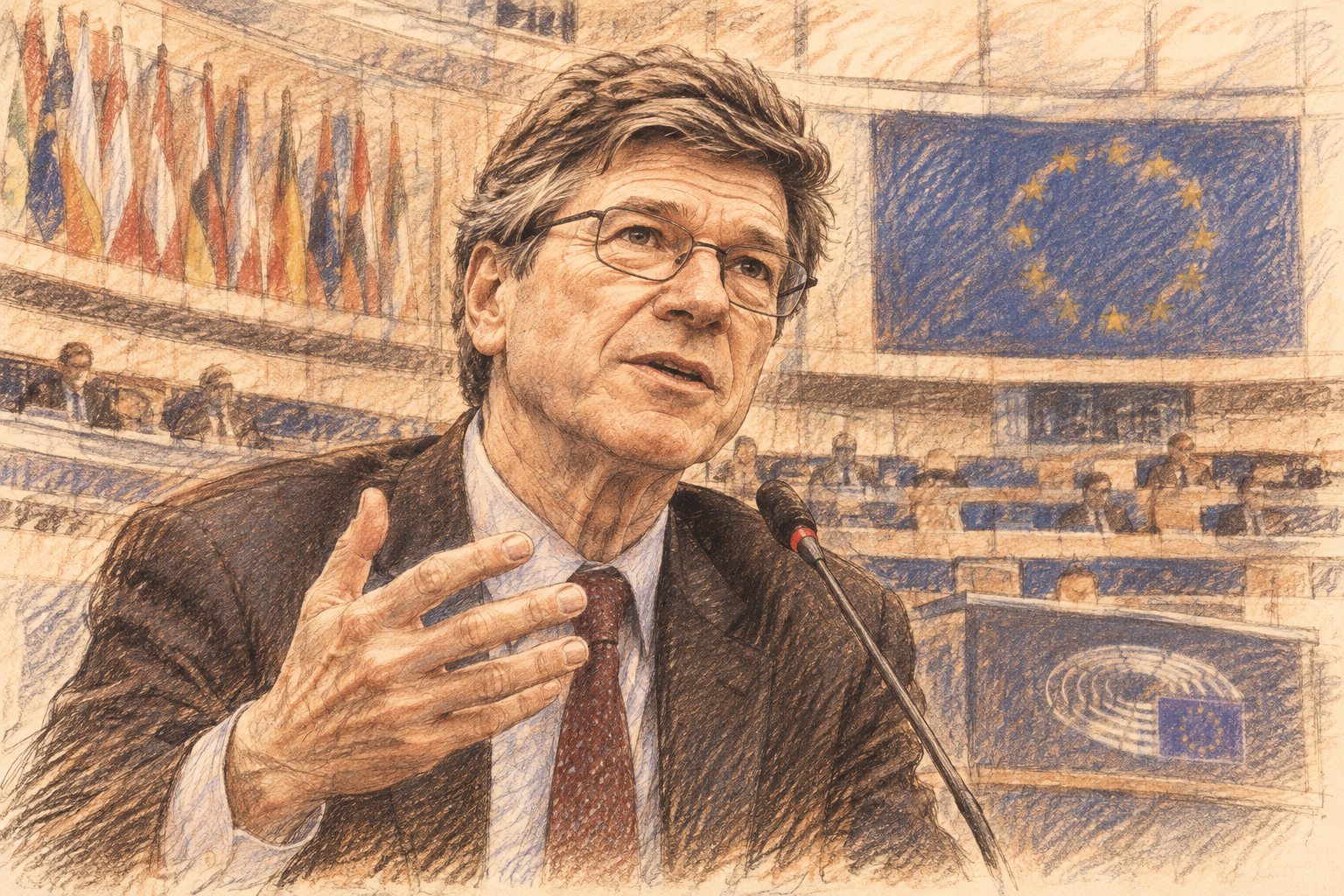
Brussels, 14 October 2026 (Transcript) Edited transcript of the video
Rome, oil, cancer cells: when growth transforms the conditions of