The poison that keeps us alive
Rome, oil, cancer cells: when growth transforms the conditions of

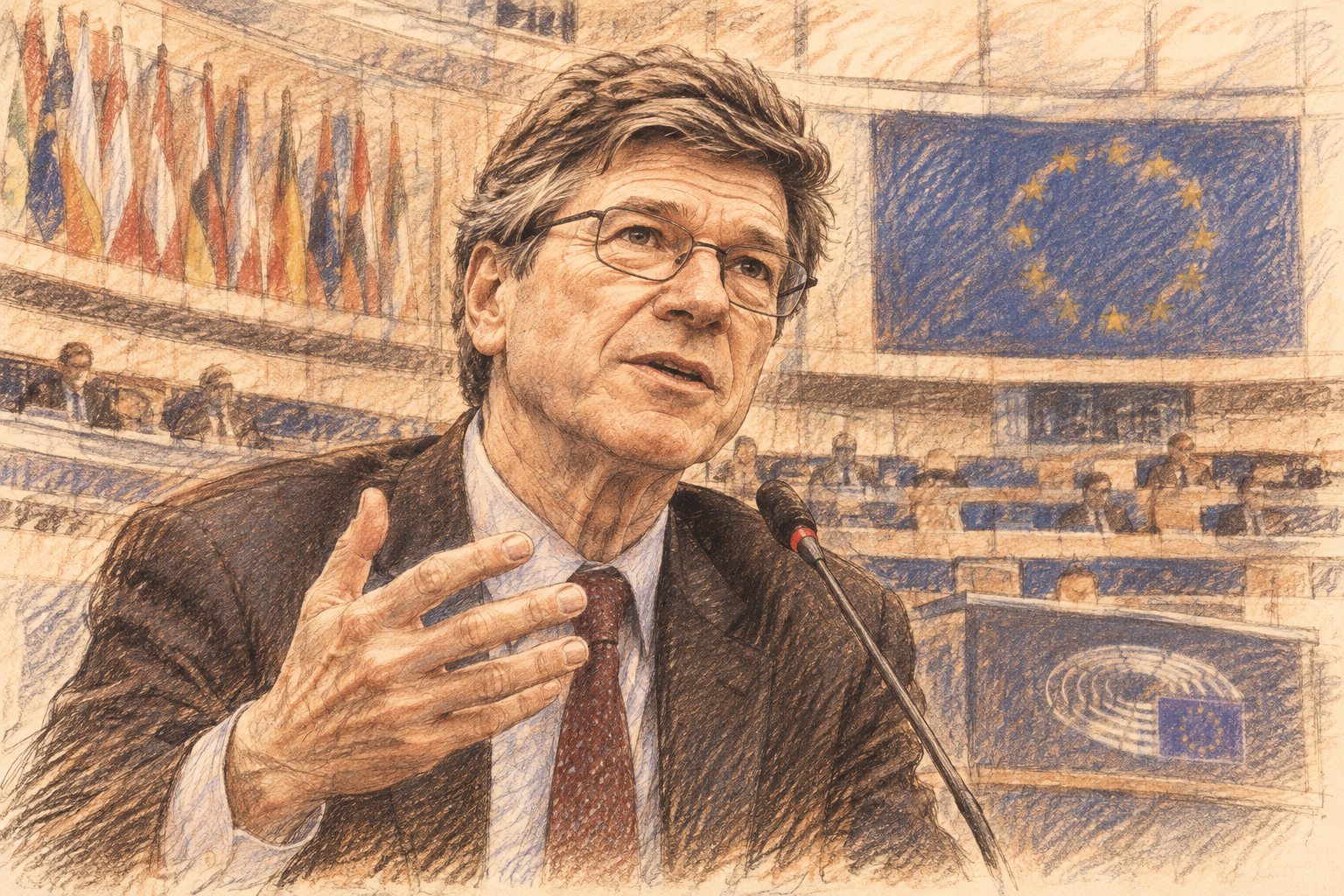

Brussels, 14 October 2026 (Transcript)
Edited transcript of the video recording. The event was hosted by Fidias Panayiotou, MEP (Cyprus), and co-hosted by Danilo Della Valle, MEP (Five Star Movement, Italy).
Fidias Panayiotou, MEP: Ladies and gentlemen, thank you so much for coming to this beautiful event. It is very important to talk about these huge geopolitical changes, and that is why we have with us the best in the world on geopolitics, I believe, Jeffrey Sachs, to help us and to give us some advice on what we should do as Europeans. We also have here my co-host, Danilo Della Valle, a Member of the European Parliament from the Five Star Movement in Italy. Jeffrey, the stage is yours. We will give you ten or fifteen minutes to explain your thoughts, and then we will take questions from Members of the European Parliament and have a discussion.
Jeffrey Sachs: Perfect. It is a great pleasure to be together with all of you. Thank you for the occasion, and thank you for the chance to brainstorm.
The world is in a very, very strange place. The United States, of course, is in a very deep political crisis. Europe, I would say, is also in a political crisis. The continent is at war, and the world is changing very rapidly. So this is not exactly a safe moment, or a moment that is easy to understand, but I want to share my thoughts with you from a constructive point of view: how we proceed to make peace consciously and affirmatively. If we continue the way we are going, honestly, any terrible thing can happen. The rhetoric of war that has overtaken Europe is shocking and extremely dangerous. Compound that with a completely failed American politics, in the country that is supposed to be your ally. I can tell you that we have never had a worse president in our history, nobody more incompetent, unstable, dumb and dangerous from the point of view of character. He is a pathological figure on top of all his other limitations. You really need to take care of Europe, and that is not happening right now.
There is so much to discuss and so many ways we could start the discussion, but let me start with the big picture. The big picture is that the world has changed dramatically in the last quarter century, most importantly with the rise of Asia, above all the rise of China, and the return of Asia to centrality in the world economy and in world geopolitics. All in all, I view that as a very good thing, not a dangerous thing. Asia found itself very poor after a century and a half of European imperialism. It regained effective independence after World War II, and it has since substantially ended poverty and recovered a prosperous economy. This is wonderful news, because it means that for four billion people there has been a marked improvement in well-being, in material conditions and in economic life generally. That is true of China, of India, of Southeast Asia and of Central Asia, and it is one of the glorious achievements of the world over the last half century.
It is viewed with alarm in the United States and in much of the European political class. In a way that is understandable, though profoundly wrong. It is understandable because the so-called Western world, basically the North Atlantic world, ran the show for about 200 years, from the end of the Napoleonic Wars until around the year 2000. First Britain was in the driver’s seat, building the largest empire in history in the nineteenth century and the first half of the twentieth. Then, after 1945, the United States became the inheritor of the British Empire. This was the Western world, the world of values, and so on and so forth. But these Western values were values under which Britain allowed tens of millions of people to starve to death under its so-called laissez-faire policies, in India, in Ireland and in many other places. This was a world of imperial rule, in Cyprus as well, and of imperial genocides. It was not a world of values, except the values that we wanted to proclaim for ourselves.
One of the main implications of all this is the following. In 1820, on the eve of Western hegemony, Asia constituted about 60 percent of world output, as best we can measure it. By 1950 it constituted about 20 percent of world output, while its share of world population remained about 60 percent. Asia experienced a calamitous 150 years, roughly from the beginning of the nineteenth century to the middle of the twentieth. This was the period of Britain’s control of India and of the West’s effective control over much of China. It was the period of China’s massive civil war, the so-called Taiping Rebellion, probably the biggest civil war in history, which took tens of millions of lives in the middle of the century in the wake of the British wars against China. It was the period of the complete colonization of Southeast Asia, and of other disasters that befell the region through European and American imperialism and through the two world wars. China, after all, lost 15 to 20 million people to Japan’s invasion from 1937 to 1945, a little-known but absolutely brutal calamity for China.
So Asia fell to about 20 percent of world output, while the Western world, the United States and Europe together, accounted for more than 50 percent of world output even after the devastation of World War II. That was the starting point of the postcolonial period. What has happened in the 75 or 76 years since 1950 is that Asia has recovered its place in the world. Asia was 60 percent of world output in 1820 and 20 percent in 1950, and it is now about 50 percent. It has not fully closed the gap that opened during the period of imperial domination by the West, but it has substantially done so.
I am a development economist. I have worked in China for more than 40 years, and in India, off and on, for more than 40 years. For me this is a great success story, to watch poverty end and economic development take hold. I can tell you from firsthand observation that the Chinese people worked around the clock for 40 years to accomplish this. You would go somewhere at night and buildings would be going up all through the night on bamboo scaffolding by torchlight. People were building the Chinese economy, and living standards rose. People could feed their families again, when before they had been hungry; in Mao’s disastrous Great Leap Forward, after all, millions of people died between 1958 and 1961. People could send their children to school, and from the late 1970s onward they could send their children to Europe or to the United States for an education. Many of my students from those years are now senior officials in the government or senior professors in universities, and they live good and decent lives that are the result of decades of extremely successful development and hard work.
All of this is taken as a disaster in the United States, and the talk in the United States is of preparing for war. We are nearly at war with China. Why? Because China has grown up again. In fact, they have the unbelievable temerity to have a larger economy than the United States. Can you imagine? This is China’s insolence. Of course, they have four times more people, so the only way they could have a smaller economy would be to remain at less than one quarter of our per capita income. They decided they did not want to do that. They decided they wanted to have a normal life. And lo and behold, if you multiply a normal life by 1.4 billion people and compare it with the United States and its 340 million people, China ends up being bigger in absolute terms. That is almost a casus belli. How dare they threaten American hegemony? Sorry, we do not use that term. How dare they threaten American primacy, which is the strategic objective of the United States?
There is a second profoundly misbehaving country as well, and that of course is Russia. I want to say that Russia’s biggest crime is that it has 17 million square kilometers. That is its biggest crime. Why do I say that? Because with 17 million square kilometers, Russia became an enemy of the British Empire by 1840, and it became an enemy of the United States of America when the United States took over from the British Empire in 1945. No matter what Russia or the Soviet Union does, it is an enemy. And if you behave that way long enough, you end up with the Ukraine war.
There is a lot to talk about here. What I have just said makes me a Putin apologist, a vile mouthpiece of Russian propaganda, and every other slur that might be thrown at me. But I have been working there firsthand for 37 years. I am no one’s apologist. I have never been on anyone’s payroll, by the way, in case anyone ever hears anything to the contrary. I made it a policy 40 years ago, when I started advising Bolivia and someone attacked me politically for being an external adviser. I decided on the spot that I would never take a penny from a government, and I have advised dozens of governments with nothing other than my academic salary. So, to be absolutely clear, nothing that I am saying is because I am anyone’s consultant or anyone’s paid employee. I never have been, and I do not even have to check the books, because that has been my policy my entire career.
So I am not a Putin apologist, but I am a great admirer of Mikhail Gorbachev, because he was the greatest man of peace of our age. He wanted a common European home, and it was open to Europe to have it. It was actually promised by the Germans on the occasion of German reunification. On 31 January 1990, in Tutzing, Foreign Minister Hans-Dietrich Genscher said explicitly and unequivocally that NATO would not expand eastward in the context of German reunification. You can find that speech online, so go look at it. On 9 February, U.S. Secretary of State James Baker III said to Gorbachev that NATO would not move one inch eastward. On 10 February 1990, Chancellor Helmut Kohl told the same thing to Gorbachev face to face.
I was not in those meetings, but I was in Berlin in those weeks and months, because I was an adviser to Gorbachev’s economic team in 1990. In 1989 I had been the main external adviser to Poland, and I watched Gorbachev make possible the democratic transformation of Poland. You might be surprised to know that Gorbachev intervened actively to tell General Jaruzelski to bring those nice young people from Solidarity into the government. That is how revolutionarily peaceful things were in 1989. I met Chancellor Kohl and I met Foreign Minister Genscher, because I was working on the economic issues of the transition.
We had peace in our hands for a century to come, if we wanted it, because the Russians were rather exhausted after seven decades of Bolshevism. It was not exactly the most proficient economic system. They wanted out. They wanted peace, cooperation and friendship. The word that Yeltsin used with me more than any other was “normal”: “Mr. Sachs, we want to be normal. We want to be normal politically. We want to be normal economically.” Review all the conciliatory things that President Putin said when he came to the Bundestag and when he visited European institutions after he came to power, because he said exactly the same thing.
So what happened? What happened with Russia is the same thing that happened with China. Your friend, ally and supposed protector, the United States of America, my country, got it into its bright little head in 1992 that it now ran the world. That came to be called neoconservatism; call it what you want. Everybody believed it, Democrats and Republicans alike.
I saw this firsthand, because in 1990 I had a basic and naive idea that I had learned as a student of the writings of John Maynard Keynes. When someone is defeated, you help them, so that the next generation does not turn against you. That is what Keynes wrote in The Economic Consequences of the Peace in 1919, which was the most important book for me personally and for my career. Keynes was saying, in effect, that good economics also means being decent, which is the clever thing to do over the long term, for yourself and for everybody else. Do not be vindictive, because it will boomerang. So in 1990 I had a naive idea: why don’t we help the Soviet Union? It was in an economic crisis, with a big financial crisis, and helping would have cost us almost nothing. Gorbachev wanted to make reforms. He was the great statesman of peace. Let’s help him.
I proposed a package, the same kind of package that I had proposed for Poland, which had been adopted. I thought, what a convincing economist I am. But it had been adopted for Poland because Poland was to be the eastern end of NATO, though I did not know that at the time. It was adopted by the geostrategists not because they liked Poland, though there were a lot of Polish voters in Chicago and Detroit, but because Poland was on our side. When I proposed the same for the Soviet Union, it was turned down entirely.
About two years ago, more than 30 years after the fact, someone sent me the minutes of the National Security Council meeting at the White House on 3 June 1991, at which my proposal was turned down. They had been released under the Freedom of Information Act. I had never seen them, and if anyone wants to write to me, I will send them along. It is the most stunning display of American imbecility you can imagine, and that is saying a lot, because our country is filled with imbeciles. I am talking about the leadership; the public understands a lot better. Do you know what they said about the proposal? Richard Darman, who was head of the Office of Management and Budget, put it this way: “We have enough ingredients already for a good PR package. The list doesn’t need to grow. We shouldn’t shoot our wad now. Mikhail Gorbachev is a showman. He will pressure us no matter what.” I mention his name because he had been my colleague at Harvard and then went to OMB and dismissed the idea of helping Gorbachev. Reading the minutes of that meeting is like watching amateur hour: a group of arrogant ignoramuses sitting around the table asking, in Darman’s words, “What is the minimum amount necessary from us to mollify a regime with which we wish to work on other matters?” So that is American foreign policy. That is your ally and protector, the great savior. That is “Daddy,” to use the current technical language.
Russia’s big crime was that it is big, just like China’s big crime. I have just published a book in German, released yesterday, about Russophobia in Europe. In its first chapter I recount a wonderful study by the historian John Howes Gleason, published in 1950, called The Genesis of Russophobia in Great Britain. Gleason asked a poignant question that is completely relevant for us today. Britain and Russia were allies in the Sixth Coalition that defeated Napoleon in 1813 and 1814. Some twenty-five years later they were enemies. What happened? Why did the British come to hate the Russians? So he studied Hansard and every other published record. He read everything that was said in the House of Commons and every speech. His conclusion in this wonderful book is that Russia did nothing. Britain simply got it into its head that Russia was so big that it was a threat to India, to the British Empire in India, and that it was going to invade India through the Khyber Pass. That was the Great Game, something that never crossed the Tsar’s mind, by the way. But Britain talked itself into quite a froth, and by 1840 Russia was the enemy.
In 1854 Britain went to war in Crimea, with Palmerston, the quintessential imperialist, as the war’s leading champion and, from 1855, as Prime Minister. Why? It is a long story, but basically it was to crush Russia in the Black Sea. In 1853 Russia accepted the Vienna Note, a diplomatic resolution of the crisis over Wallachia and Moldavia, and there was no reason for conflict. Yet Britain pressed on, and Palmerston said, we move on to Sevastopol. The reason was that he wanted to make Russia a nonentity, so that it could not threaten the British Empire. That is called Western values, by the way. There followed a three-year bloody war, the Crimean War.
Let me come back to the present. We are in the second Crimean War, and we are in it for exactly the same reason that Palmerston and Napoleon III launched the first. This is not Putin’s war. This is our war, ladies and gentlemen. It came about in a slightly different way, but a very similar one. Our strategists in the 1990s got it into their heads that the United States was the primary power of the world. Choose your phrase: we are the world’s sole superpower; we are the indispensable nation; we are, as one of my least favorite secretaries of state, Madeleine Albright, said, the country that sees farther than any other. Look up what America says about itself. All the American strategists could think about was: what are our threats? Well, really none. We are so powerful that no one can face us down. The only one we can see is Russia. Russia is big, so we just have to make sure that it remains a third-rate power, or that it breaks apart, as Brzezinski wanted.
If you want to understand why we are in this Crimean War, read Brzezinski’s book The Grand Chessboard, whose subtitle is American Primacy and Its Geostrategic Imperatives. The book is about how the United States keeps its primacy in Eurasia. Excuse me, but the United States is not a Eurasian country, and yet it is going to have primacy in Eurasia. And you are going to help, ladies and gentlemen, aren’t you? That is so kind of you. You will host all our military bases and you will do what we say.
What was decided, contrary to what Mr. Genscher, Mr. Kohl and Mr. Baker said in January and February 1990, is that we would surround Russia with NATO and with Aegis missile systems. The United States abandoned the Anti-Ballistic Missile Treaty in 2002, for no good reason, even though the absence of anti-ballistic missiles was the stabilizing bulwark of the nuclear security system. The United States walked out of the treaty in 2002 and began placing Aegis missile systems in Poland and Romania. The Russians said that they did not like this. And they did not just say it after the fact. They said it every year from 1991 onward, as it became clear that the words that had been the basis of the Two Plus Four agreement were being completely abandoned.
By 1994 Clinton had decided that NATO would expand. His own Secretary of Defense, William Perry, who is a real gentleman, thought about resigning because he considered this terrible. Our leading statesman, George Kennan, famously wrote in 1997 that NATO expansion would be the most fateful error of American policy in the entire post-Cold War era. Kissinger, who was not a sweet man, by the way, had a debate in 1994 that you should all watch, because it will also explain the war to you. He debated Jack Matlock, our ambassador to the Soviet Union in its final years. We used to actually have news in the American media; you could have a grown-up debate, a half hour on a serious issue. We do not have anything like that anymore. In 1994 Robert MacNeil interviewed Kissinger and Matlock about NATO enlargement. MacNeil asks Matlock whether NATO should enlarge, and Matlock says no: we are building better relations with Russia, there is no risk, and there is no reason to provoke anything. Then he turns to Kissinger: “Mr. Kissinger, should NATO enlarge?” “Yes, NATO should enlarge.” “Why? Is Russia a threat?” “No, no, Russia is no threat.” “Well, are these countries asking for NATO membership endangered?” “No, they’re not endangered at all.” “Well, Mr. Kissinger, won’t this antagonize Russia?” “Yes, it will.” “Then why, Mr. Kissinger, should NATO enlarge, if it would antagonize Russia?” And Kissinger answers: if you cannot antagonize Russia when it is weak, what are you going to do when it is strong? That is the logic.
So NATO proceeded, and proceeded again: first in 1999, with three countries, Hungary, Poland and the Czech Republic; then, as you know well, in 2004 with Estonia, Latvia, Lithuania, Slovenia, Slovakia, Romania and Bulgaria. Then in 2008 the genius George Bush and his wonderful peacemaker Dick Cheney announced at the Bucharest NATO summit that we were going to go all the way to Ukraine and to that great North Atlantic country, Georgia. Georgia is not a North Atlantic country, by the way. I checked. It is not even a European country. And Europe should also understand: do not drag Armenia into this. Armenia is not part of Europe either. Please leave them alone before something terrible happens, just as with Ukraine. You are playing with exactly the same fire there as with Ukraine.
So the Bucharest NATO summit takes place in 2008, and on the first day Bush says that we need to commit to NATO enlargement to Ukraine and Georgia. Chancellor Merkel says, “George, I don’t think that’s a good idea. That’s a Russian red line. It is really not safe.” “Angela, Angela, come on. We need to agree here. We are the Western alliance. Don’t hold back.” They put on the pressure, and on the second day they compromised. They announced that NATO would expand to Ukraine and Georgia, but without a date. Look at Merkel’s memoir, published in 2024. She writes that this would be heard in Russia as tantamount to a declaration of war.
As far as I am concerned, that second day of the Bucharest summit was the last day of European foreign policy. Europe should have stood up and said: this is baloney, this is a provocation, this is completely unnecessary. Europe should have stopped it cold. Instead Merkel caved, the French caved, and that was the last we ever heard of European foreign policy. Frankly, no one has said a word to the Americans since then, except recently, and even then only: “Please, Daddy, don’t invade Greenland. We will give you all the bases you want. You can do anything you want. You can have all the minerals. Just don’t invade.” And second: “Please don’t do the diesel deal,” Trump’s deal with Putin to lift the sanctions on Russian diesel exports. I admit that the diesel deal shows that this man is the most idiotic and incompetent person ever to hold the presidency, simply because he cannot hold a consistent idea for a day at a time. I would put it at fifteen minutes at a time, by the way. But Europe might have said something different about many other issues during the last fifteen years, and it did not. When the United States bombs Iran, unprovoked, and murders its leaders, do you think there is a murmur from Europe? I have not heard one. Everything seems to be fine, except if you are Pedro Sánchez, whom I admire tremendously. He says that this is not right, and within weeks the judicial case against his wife is revived and widened. So the games are everywhere. But in my view Europe gave up its sovereignty on the second day of the Bucharest NATO summit, and you can watch the march to war from there.
Yanukovych was rather clever, actually. He said that Ukraine should be neutral, and he was right, and the Ukrainian public overwhelmingly said, roughly 60 to 20 percent, do not bring NATO here. The United States said that we have to get rid of this man. You can call it the Maidan Revolution of Dignity if you want. I call it the coup. You could call it the regime-change operation, or the color revolution; use whatever name you want. But my colleague Victoria Nuland distributed cookies on the Maidan, and the United States had spent about $5 billion to help bring it about. We needed to get rid of him, because NATO enlargement needs countries that call for the Western alliance, not countries that call for neutrality.
On 21 February 2014, the German, French and Polish foreign ministers negotiated an agreement with Yanukovych for a constitutional continuation of government, with a unity government and elections later in 2014. The next day there was a violent coup. I mean violent, because it is now well understood that the killing in the streets of the Maidan was carried out by right-wing forces shooting from buildings that the Maidan movement controlled. Read Ivan Katchanovski if you want the gruesome details, in hundreds of pages of testimony. This was a setup. The next day Yanukovych was deposed, and the United States immediately recognized the new government. It did not say, wait a minute, this is extra-constitutional and we want to make sure that the Ukrainian constitution is respected. And Europe did not even have the gumption to say, excuse me, we had an agreement the night before. Not a word. Europe immediately fell into line.
So you get a coup, and of course everything follows from that. Russia intervenes in Crimea and the Donbas. Of course it intervenes; it knows what it is facing. And it proposes, the following February, something that was actually not bad, namely the Minsk agreement. The Minsk agreement is very interesting, because it was not a Russian claim of territory. It was not President Putin playing Peter the Great to rebuild the Russian Empire, or any of the rest of what you hear from the absurd propaganda in Brussels, in Berlin, in Washington and especially in London. It was nothing like that. It said: give autonomy to the ethnic Russian region. And do you know where the idea came from, to a large extent? It came from Bolzano, from South Tyrol in Italy, because Merkel knew the experience of the German-speaking minority in South Tyrol, which had been quite successful and very prosperous. We talked with the mayor of Bolzano, who said that Merkel came often and thought it would be a great model for Minsk II.
And it would have been, except that the United States said no: Ukraine is a unitary state. This despite the fact that the Minsk II agreement was signed and then endorsed unanimously by the UN Security Council. The United States and Ukraine said no thanks, and Europe fell into line. There was the Normandy process, you will recall, in which Germany and France were to be the guarantors of the Minsk II agreement, and they completely fell silent. Merkel herself said afterwards that this was just a holding period and not a real agreement. I do not believe, by the way, that she meant that at the beginning. She is better than that. But that is what she was told to say after the fact, and that is what happened. So the Minsk II agreement disappeared.
Then a very interesting part of the story picked up. Trump says, by the way, that if he had been president there would not have been a war. Trump, to use another technical term of international relations, is the biggest bullshitter ever, on every single issue. He presided over the building of a million-person, NATO-interoperable army in Ukraine. Thank you. That was his doing, between 2017 and 2021.
Rome, oil, cancer cells: when growth transforms the conditions of
At MIT, researchers have discovered that an artificial intelligence model

At Palazzo Roverella, a journey into the visionary world of