From a wall in Pompeii to medieval amulets: how twenty-five Latin letters crossed the centuries, gathering meanings they may never have possessed at the outset.
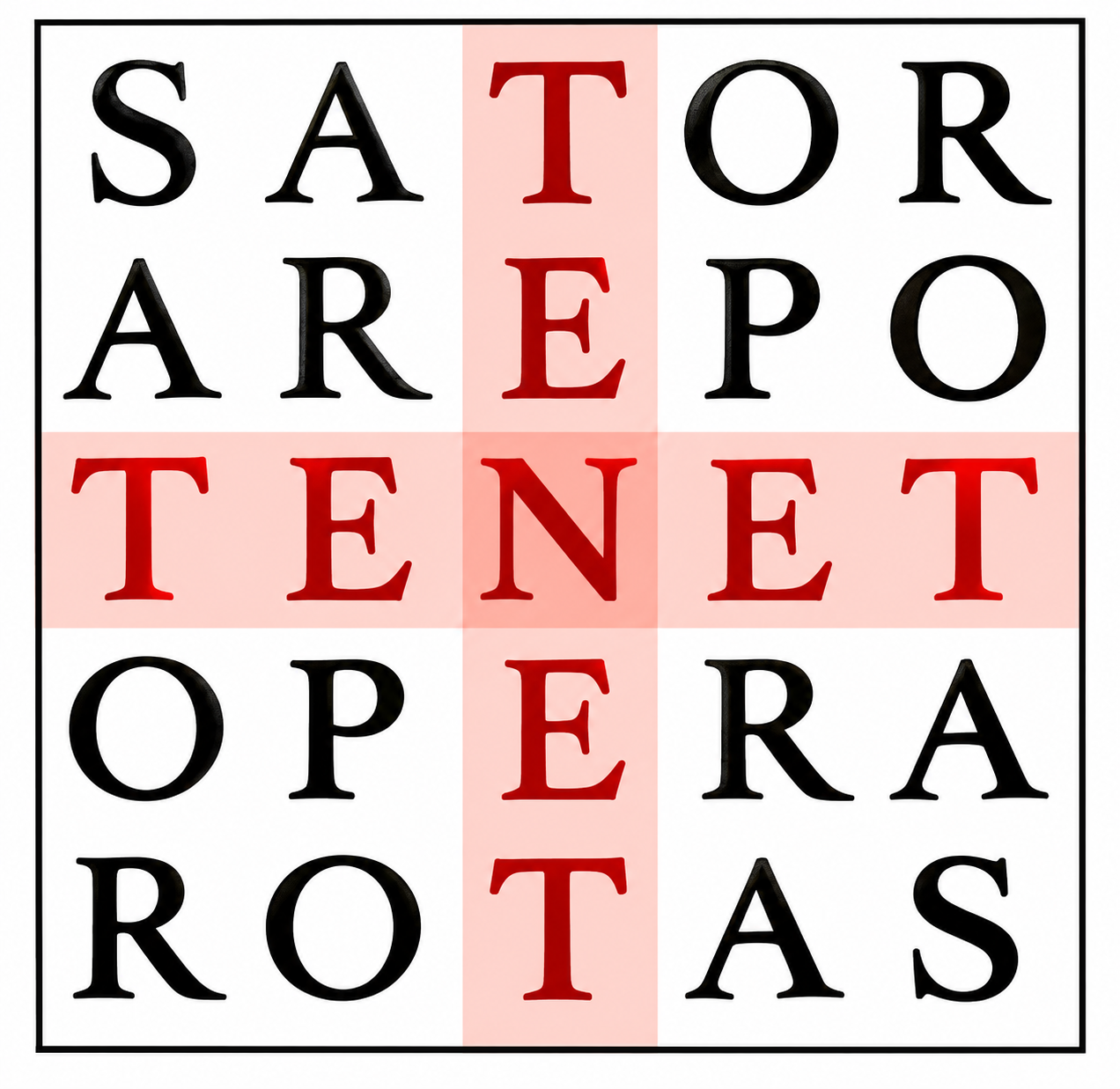
Some riddles await a solution. Others, after receiving so many, end up telling us more about the people who tried to solve them. The Sator Square belongs to the second category. Five Latin words arranged in five rows of five letters. Twenty-five characters, perfect symmetry, uncertain meaning.
S A T O R
A R E P O
T E N E T
O P E R A
R O T A S
It can be read from left to right and right to left, from top to bottom and bottom to top. The sequence remains the same. At its center stands the N of TENET, a word meaning “holds,” “supports,” or “maintains.” TENET itself forms a cross, horizontally and vertically, at the heart of the square. The construction is so exact that it seems deliberately charged with meaning. But that impression, however compelling, is not evidence. The first mystery of the Sator is that we know exactly how it works, but cannot say with certainty why it was invented.
Before the mystery, the stone
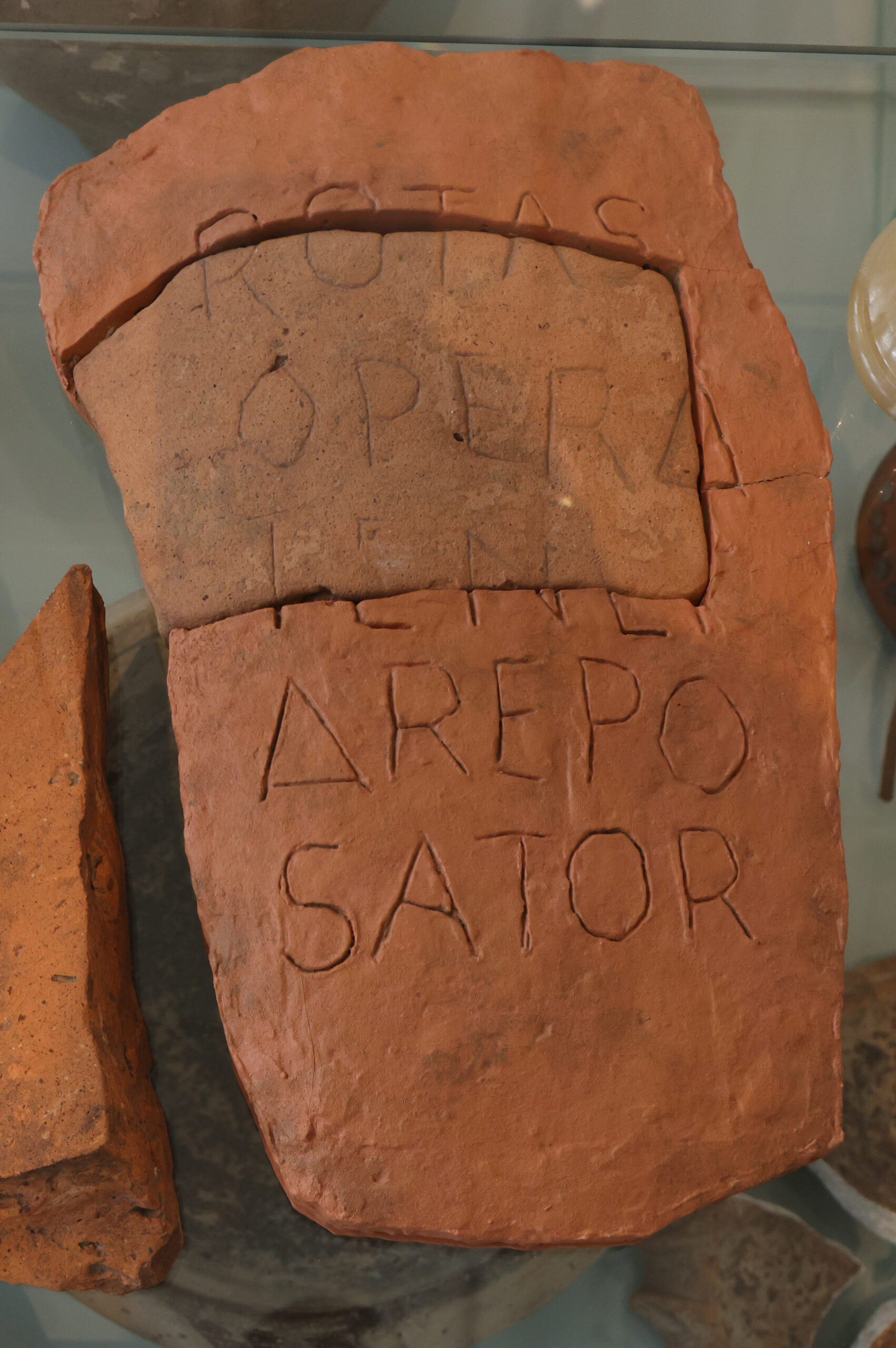
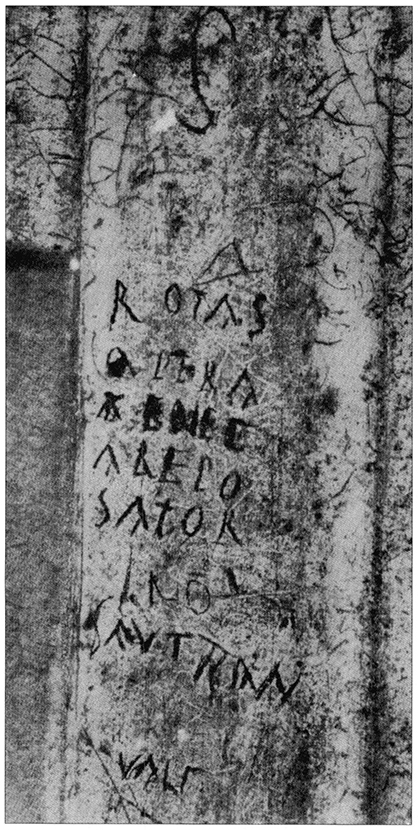
One of the most important certainties comes from Pompeii. Two examples of the square were found in the city buried by the eruption of Vesuvius in AD 79, in the arrangement beginning with ROTAS and ending with SATOR. This establishes an unassailable chronological limit: the formula existed before AD 79. It does not establish when it was composed, who devised it, or what purpose it served for the person who inscribed it. The distinction matters. The date of an inscription is not necessarily the date when the words it contains originated. The square subsequently appears elsewhere in the Roman world. Examples are known from Britain, Aquincum (in present-day Budapest), and Dura-Europos, a city on the Euphrates where Greek, Semitic, Iranian, and Roman traditions coexisted. In Manchester, a pottery fragment bearing the square has been dated to around AD 180. At Dura-Europos the formula also appears in a painted inscription now held by the Yale University Art Gallery. This is therefore not an isolated inscription confined to one corner of Roman Italy. Whatever its original purpose, the formula could travel, be copied, and be recognized in widely separated places. But recognized as what? A word game? A sign of belonging? A protective formula? A religious message? The earliest evidence does not allow us to choose with confidence.
The problem of Arepo
If the square were merely an exercise in symmetry, it would already be a small combinatorial masterpiece. The trouble is that it also seems to form a sentence. Sator means “sower” and can figuratively mean “creator” or “progenitor.” Tenet is the verb “holds.” Opera can mean work, activity, or effort, and may have other senses depending on its grammatical construction. Rotas is the accusative plural of rota, “wheel.”
That leaves Arepo. It is the word that prevents us from closing the circle. It has no generally accepted meaning in Latin and is often interpreted as an otherwise unattested proper name. One traditional translation, necessarily conjectural, runs roughly: “The sower Arepo carefully holds the wheels.” Other versions imagine a plough, agricultural labor, circular motion, or a cosmic order. None commands definitive agreement. We might even turn the problem around: perhaps Arepo does not conceal a lost meaning but was invented because a five-letter word was needed to complete the pattern. On this view, symmetry would have come before the message. This is an important possibility because it radically changes the question: no longer “What did the author mean to communicate?” but “How much meaning are we willing to assign to a construction that may have begun as a linguistic game?” The scholar Franco Benucci has proposed a very different reading, connecting the square with an ancient agricultural metaphor for writing and suggesting an origin in Roman literary culture as early as the third century BC. This is a historically developed interpretation, not an esoteric fantasy. But it remains a proposal: his dating of the archetype must not be confused with the archaeologically documented date of the Pompeian finds.
The hidden cross
In 1926, the scholar Felix Grosser drew attention to a property that would transform the square’s modern reception. Its twenty-five letters can be rearranged to form two intersecting PATER NOSTER sequences, crossing at the central N. Four letters remain: two As and two Os. For those seeking a Christian message, the combination is suggestive. Pater noster opens the Lord’s Prayer; A and O can be read as the Latin counterparts of alpha and omega, symbols of beginning and end in Christian tradition. The square would thus become a cryptogram: a hidden prayer, perhaps a sign by which believers recognized one another. The anagram is real. Every letter is there, in exactly the required number. But moving from the existence of the anagram to the intention of the person who composed the square is a hypothesis, not a fact. The Pompeian examples pose a chronological difficulty. Christianity already existed before AD 79, but there is no firm evidence that a Christian community in Pompeii was responsible for those inscriptions. Nor has the original use of the Pater Noster arrangement with alpha and omega as a Christian cryptogram been demonstrated. Other finds, in Roman contexts where such an early Christian presence seems unlikely, make an exclusively Christian attribution even less secure. Above all, a community can adopt a symbol without having invented it. Christians may therefore have recognized in the Sator a pattern compatible with their faith and made it their own. It is far less certain that they created it. This distinction separates two histories: the history of origin and the history of reception. The latter can be documented even when the former remains obscure.
An object that Cìchanges religion without changing its letters
The square survived antiquity. It crossed the Middle Ages and spread to regions far removed from its Roman setting. It appears in manuscripts, inscriptions, formulas, and amulets. In some contexts it was incorporated into Christian devotion; in others it was used as protection against illness, fire, danger, or difficulties in childbirth. A particularly revealing example occurs in an eleventh-century English manuscript held at Corpus Christi College, Cambridge: the Sator formula appears in a protective practice associated with childbirth. It is no longer merely a square to be read or deciphered. It is something to recite, write down, or carry. In Egypt, a Coptic-period parchment amulet preserved in Berlin contains the Latin sequence transcribed in Coptic characters, alongside other names and signs believed to offer protection. This is an extraordinary transition.
A formula composed in Latin survives even when its original language is no longer spoken by those who use it. For believers, its effectiveness does not necessarily depend on understanding the words. It may reside in their arrangement, repetition, or the very shape of the sign. The text becomes an object. And here we encounter an unexpected connection: that between writing and the amulet. We normally think of writing as a means of conveying content. But in many traditions a written sequence can act symbolically even when it is not understood. It is not merely used to say something: it is treated as something that does something. The Sator stands precisely on this boundary.
The gnostic temptation
A symmetrical construction, enigmatic words, a hidden cross, possible allusions to a creator and to cosmic order: it is hardly surprising that the Sator has also attracted Gnostic, Hermetic, and initiatory interpretations. The temptation is understandable. In the early centuries of the Roman Empire, different religious languages, magical practices, cosmological speculations, and forms of syncretism circulated side by side. The world in which the square spread was not divided into sealed compartments. But a receptive cultural environment is not the same as a demonstrated genealogy. We lack sufficient evidence to attribute the composition of the Sator to a particular Gnostic community, Hermetic school, or mystery cult. We can study its compatibility with certain religious imaginaries. We cannot turn that compatibility into proof of origin. The same applies to later numerological and cosmological readings. The five-by-five structure invites associations with numbers, elements, directions, planets, and sacred geometries. Some correspondences can be constructed. But the fact that they can be constructed does not show that they were present in the ancient author’s mind. This is one of the most fascinating problems in the history of symbols: a sufficiently ordered form can generate an almost inexhaustible range of interpretations.
A mistery is not a safe
Faced with the Sator Square, we tend to imagine an author concealing a precise message, as one might lock a document in a safe. Historical research does not rule out that possibility. But it does not entitle us to take it for granted. Perhaps the square began as a word game and became a religious symbol. Perhaps it had a ritual function from the outset that we can no longer reconstruct. Perhaps it already combined several layers of meaning. We cannot definitively choose among these hypotheses. What we do know is equally interesting: the same set of letters was copied, reinterpreted, and used for different purposes across the centuries. The Christian anagram, medieval childbirth formulas, Coptic amulets, and modern esoteric readings are not necessarily fragments of a single original truth. They may be successive layers deposited on an object that continued to circulate precisely because of its ambiguity. In this sense, the Sator is less like a riddle to be solved than an archaeological object to be excavated. Each interpretation tells us something about the age that produced it. And perhaps its most enduring mystery lies not in what it conceals, but in what people have continued to seek within it for almost two thousand years.
Sources on the Sator
- 1. Guillaume de Jerphanion, “À propos des nouveaux exemplaires, trouvés à Pompéi, du carré magique ‘Sator’,” Comptes rendus de l’Académie des Inscriptions et Belles-Lettres, 81, 1937, pp. 84–93. Full text on Persée. A historical reference for the Pompeian discoveries.. Testo integrale su Persée.
- 2. Duncan Fishwick, “On the Origin of the Rotas-Sator Square,” Harvard Theological Review, 57, 1964, pp. 39–53. Cambridge listing. Examines the Christian interpretation and the PATER NOSTER anagram. Scheda Cambridge.
- 3. Jean Orcibal, “Dei agricultura: le carré magique SATOR AREPO, sa valeur et son origine,” Revue de l’histoire des religions, 146, 1954, pp. 51–66. Full text on Persée. A historical, religious, and linguistic reading. Testo su Persée.
- 4. Franco Benucci, “Rotas opera tenet, arepo sator. Un’interpretazione del ‘quadrato magico’ pompeiano,” 2008. University of Padua repository. Proposes a third-century BC archetype and reads the text as a “scribe’s lament.” Note: this is an interpretive proposal, not an established archaeological dating. Archivio dell’Università di Padova.
- 5. Paul Veyne, “Le carré Sator ou beaucoup de bruit pour rien,” Bulletin de l’Association Guillaume Budé, 27, 1968, pp. 427–460. Full text on Persée. Particularly valuable: Veyne questions the very process by which intentional meanings are attributed to combinations of letters. Almost a lesson in method for Isobare Testo integrale su Persée.
- 6. Nicolas Vinel, “Le judaïsme caché du carré SATOR de Pompéi,” Revue de l’histoire des religions, 223, 2006, pp. 173–194. On OpenEdition. Proposes a Jewish origin for the square, an alternative hypothesis to the Christian reading. Testo su OpenEdition.