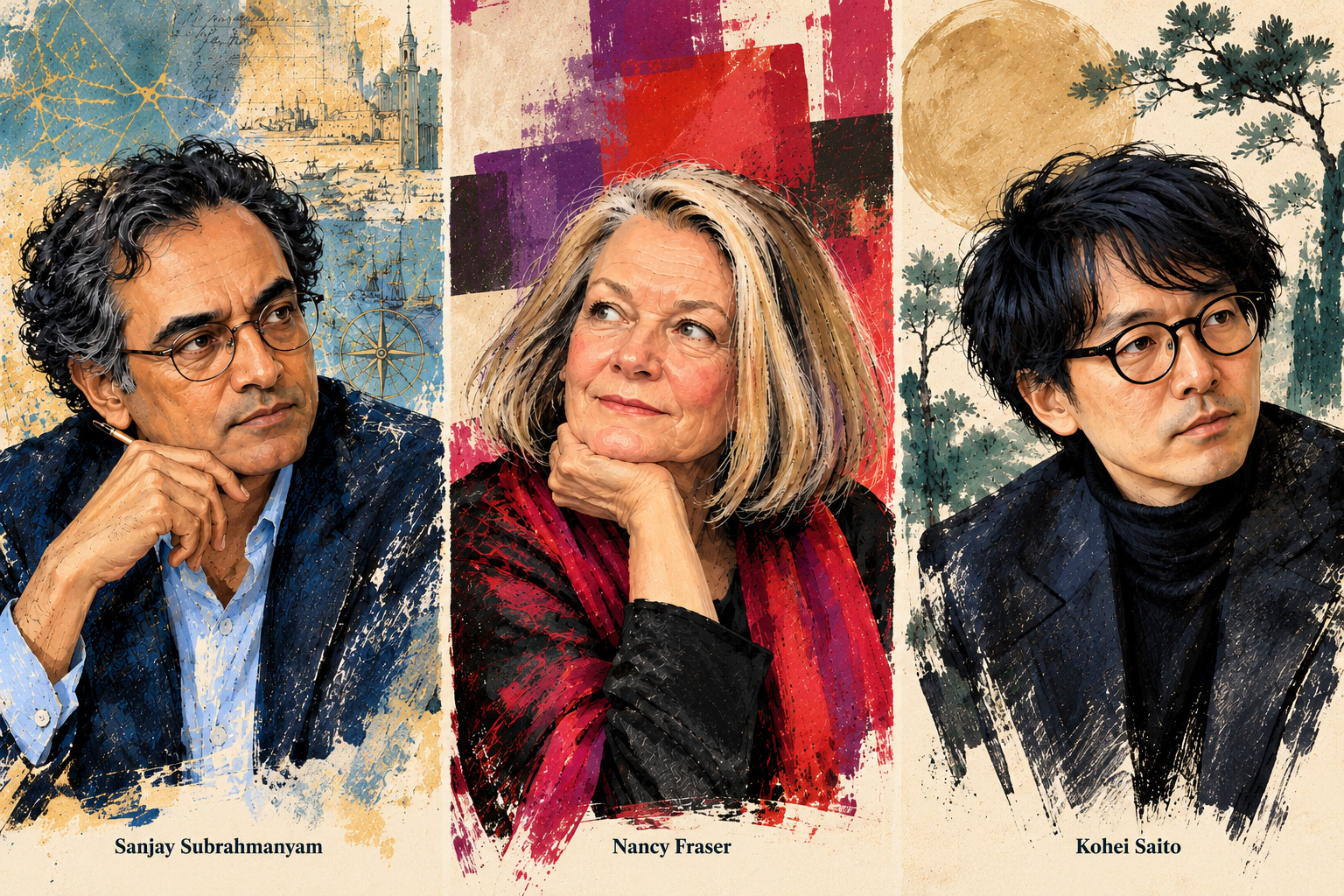
Some people look at the world from unexpected perspectives, challenge established interpretations, and open up new paths of inquiry. In each instalment, Thinking Heads introduces three voices from contemporary intellectual life, working in different disciplines and countries. They need not agree with one another, but each deserves to be heard.
Sanjay Subrahmanyam – History has no centre
What happens to world history if we stop telling it as a succession of separate civilisations, each with its own territory, culture and destiny? Sanjay Subrahmanyam, an Indian historian who teaches at the University of California, Los Angeles, has devoted much of his work to challenging this picture. His approach of “connected histories” starts from an apparently simple observation: people, goods, knowledge, beliefs and institutions crossed boundaries long before historians began drawing their disciplinary maps. Studying Europe, India, Persia or the Ottoman Empire in isolation often means overlooking the very relationships that helped transform them. Comparing different civilisations is not enough: we must reconstruct encounters, translations, conflicts and mutual influences through documents produced in different languages and settings. This requires extraordinary familiarity with archives and a healthy distrust of grand narratives. In his work, the history of European expansion is no longer simply the story of a West acting upon an essentially passive rest of the world. Asian societies, too, had their own initiatives, strategies, imperial ambitions and capacity to transform those who encountered them. Yet Subrahmanyam is not merely replacing a Eurocentric history with one told from Asia. His critique goes further: it challenges the habit of seeking a single centre from which everything else can be explained. Connections do not erase differences or make unequal power relations equivalent; rather, they help us understand how different worlds were shaped through their relationships. This leaves us with a question that concerns more than the past: how many of the categories through which we interpret today’s world still depend on inherited boundaries rather than on the connections we ought to examine?
Nancy Fraser — Capitalism devours what keeps It alive
Professor Emerita of Philosophy and Politics, The New School for Social Research, New York https://en.wikipedia.org/wiki/Nancy_Fraser
Can capitalism destroy the very conditions that allow it to exist? This paradox lies at the heart of an important strand of Nancy Fraser’s thought. The American philosopher has gradually broadened her critique of the economy into a theory of the contradictions of contemporary society. Capitalism, she argues, is not merely a system for producing and exchanging commodities: it depends on activities, resources and institutions that markets do not generate by themselves and often do not pay for. It relies on care work, much of it performed by women; on nature, treated as an inexhaustible source of raw materials and a limitless sink for waste; on public authority, which provides infrastructure, laws and stability; and on historical relations of expropriation that continue to distribute wealth and vulnerability unequally. Fraser calls these the background conditions of capitalist accumulation. The contradiction arises when the pursuit of profit consumes these conditions, undermining the social, ecological and political foundations on which it depends. Economic, environmental and democratic crises, together with crises of social reproduction, would therefore be not separate emergencies but different manifestations of the same social order. In Cannibal Capitalism (2022), Fraser uses the image of cannibalism to describe a system that ends up devouring its own foundations. Yet she does not reduce every injustice to economics alone: her earlier work on recognition, redistribution and political representation insists on understanding material inequalities, cultural hierarchies and democratic exclusion together. The resulting question is demanding: if the crises we face are not simply problems to be fixed, but consequences of how we have organised society, how far can reforming its rules really take us?
Kohei Saito – The Marx we did not expect
What if Karl Marx, in the final years of his life, had begun to rethink the relationship between the economy, nature and progress? This is the path followed by Kohei Saito, a Japanese philosopher who has found in Marx’s scientific notebooks traces of an ecological reflection far deeper than the conventional image of an industrialist Marxism suggests. Examining Marx’s notes on agricultural chemistry, soil degradation, deforestation and the natural sciences, Saito argues that his critique of capitalism concerned not only the exploitation of labour but also the disruption of material balances between human society and the environment. Central to his interpretation is the concept of metabolism: the continuous exchange of matter and energy through which human beings, by working and producing, participate in natural processes. Capitalist accumulation tends to disturb this relationship, subordinating it to the demands of potentially unlimited growth. But Saito goes a step further, and a more controversial one: he believes that the later Marx was moving towards a conception of society incompatible with productivism, foreshadowing what we might now call degrowth communism. Scholars debate this reading, since it attributes to Marx’s unfinished notes a theoretical evolution on which there is no consensus. Saito’s political proposal, however, extends beyond interpreting Marx. In his book Capital in the Anthropocene, which became an unexpected bestseller in Japan, he argues that the ecological transition cannot simply replace polluting technologies with clean ones while leaving the logic of economic expansion intact. Instead, we would need to rethink production, consumption, common goods and the distribution of time, distinguishing collective well-being from an endless increase in commodities. One crucial question remains: can we build an ecologically sustainable society without challenging the permanent imperative of growth?