Imagine walking through a European kitchen garden five or six centuries ago. We would find no tomatoes, potatoes or peppers: these came from the Americas and established themselves in European kitchens by long and uneven routes. Instead, we would encounter plants that are unfamiliar to many of us today, some still cultivated, others relegated to the edges of fields and paths, or to the margins of our memory. It would not necessarily be a richer garden than ours. It would be a different garden. Above all, it would require different knowledge to understand it. Many plants that accompanied European life for centuries have not disappeared at all. They still grow along coasts, as in meadows and in abandoned gardens. Some have become weeds; others survive in the markets of one region while remaining almost unknown in the next. Some have lost their economic importance; others have fallen out of use because their applications proved hazardous or more effective techniques replaced them. To tell their stories is not to mourn an imagined past in which humanity lived in perfect harmony with nature. It is to observe something more interesting: the history of plants is also the history of the knowledge that makes them useful, valuable, undesirable or invisible. Six examples take us through that history: from the chemistry of colour to international trade, from cooking to toxicology, from agricultural geography to the cultural construction of what we call a “weed”.
Woad (Isatis tinctoria): when a green leaf creates a blue economy
At first sight, woad promises few surprises. It is a herbaceous member of the Brassicaceae family, which also includes cabbages and turnips. Its leaves are green and its flowers yellow. Yet for centuries its economic destiny was bound to a colour that seems to have nothing to do with it: blue.
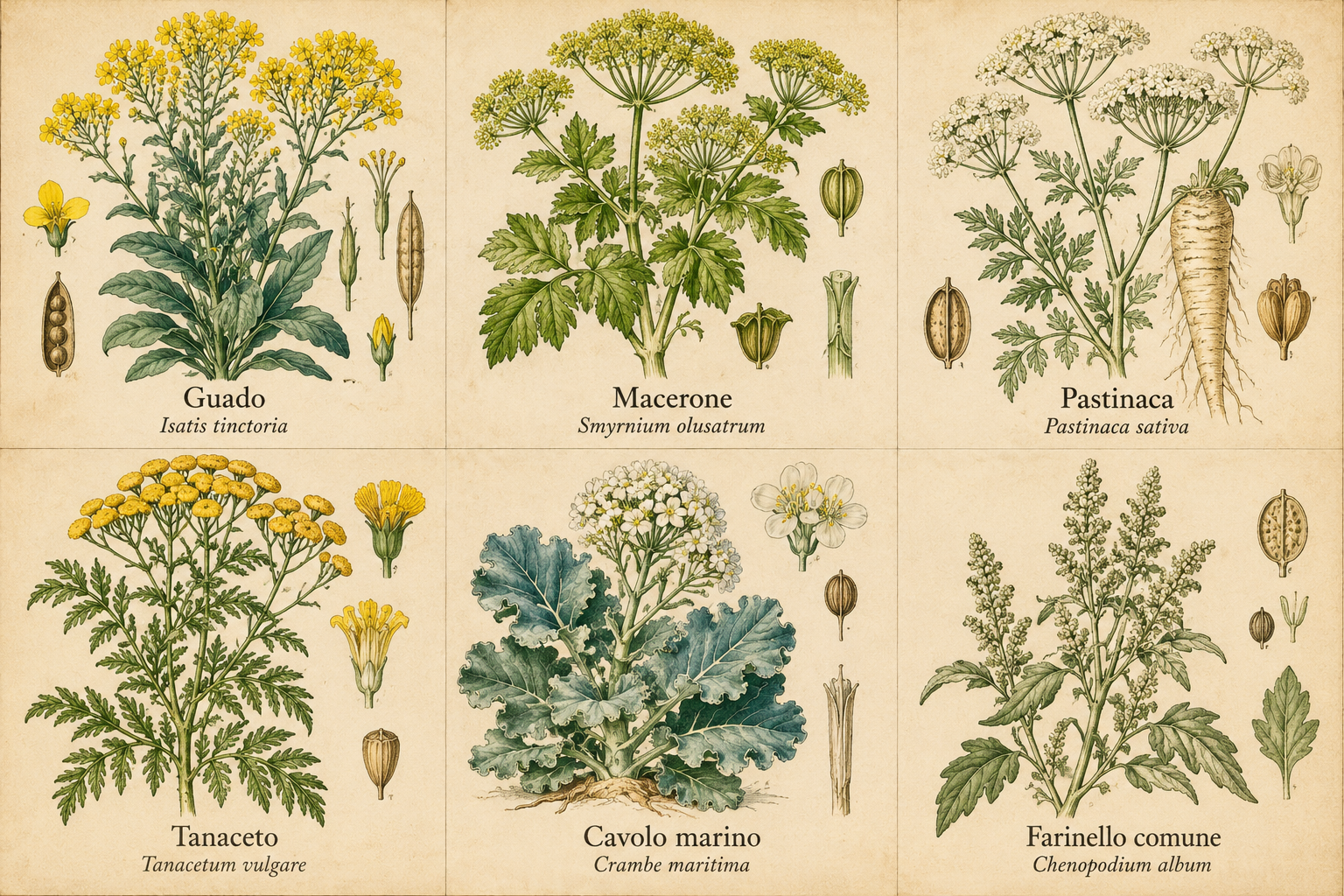
Through a series of processing stages, the leaves of woad yielded a dye based on indigotin. The process required practical expertise and chemical transformations that craftspeople mastered long before they could describe the molecular reactions involved. Woad thus became an important commercial crop in several European regions. Around Toulouse in particular, the trade in pastel contributed to the prosperity of merchants and producers between the late Middle Ages and the early modern period. Then the balance shifted. Indigo extracted from other plants, especially tropical species, entered European trade networks in increasing quantities. Later, the development of synthetic dyes transformed the dyeing industry once again. The history of woad therefore spans at least three scales: the microscopic scale of dye molecules, the regional scale of cultivation and manufacturing, and the global scale of trade. A leaf could help make a city wealthy. A change in trade routes could diminish the value of that very same leaf. Blue was not merely a colour: it was a system of production.
Alexanders (Smyrnium olusatrum): the plant that remained when its name left the kitchen
Alexanders is a robust, aromatic plant with yellow-green flower clusters. Native to the Mediterranean region, it was spread and used elsewhere in Europe. It still grows on waste ground, along roadsides and near the coast. In the past, several parts were eaten, from the leaves to the young shoots. Before the celery more familiar to us today became widespread in gardens and kitchens, alexanders held a recognisable place among aromatic and edible plants. It was not identical to celery, nor should we imagine that every European household ate it. But it belonged to a repertoire of flavours and skills that many people today can barely decipher. And that is precisely what makes it so intriguing. When a species becomes extinct, the loss is biological. When a species continues to grow but is no longer recognised, the loss is primarily cultural. The plant has not necessarily changed its form, properties or habitat. What has changed are the human practices that once gave it meaning. Recognising alexanders as food requires more than coming across it. One must distinguish it from other members of the carrot family, which includes dangerous species. One must know which parts were used, how they were prepared and what precautions were necessary. In short, a chain of knowledge must be passed from person to person. When that chain breaks, alexanders does not disappear from the landscape. It disappears from our understanding of the landscape. We can lose something without that thing disappearing.
Parsnip (Pastinaca sativa): one root, two destinies
Before potatoes became widespread, various root vegetables played an important role in European diets. Among them was the parsnip, pale in colour and slightly sweet, able to store reserves of nutrients in its root. It would be easy to tell its story as one of replacement: the potato arrived from the Americas and the parsnip was forgotten. But agricultural history rarely follows such neat formulas. In Britain, the parsnip has remained a familiar vegetable, still used in traditional dishes. In many parts of Italy, by contrast, it has become uncommon, although it has not disappeared altogether. The same plant has therefore met with different fates within the same continent. This tells us something about the introduction of new crops. The spread of a species depends not only on its nutritional qualities or productivity. Climate, farming methods, markets, tastes, customs and even the prestige attached to particular foods all play a part. Plants travel; habits do not always travel with them. The history of European food is not a single succession of winners and losers. It is a map of continuities, partial replacements, adaptations and revivals. The parsnip, almost an exotic vegetable to some and an everyday ingredient to others, shows how much our idea of “traditional food” depends on where we grew up.
Tansy (Tanacetum vulgare): when a remedy changes its meaning
With its yellow flower heads gathered in dense clusters and its strongly aromatic leaves, tansy is a distinctive feature of many European landscapes. For centuries it was used in household and medicinal practices and, in some settings, as food. It was credited with properties against parasites and various ailments. As with many aromatic plants, its uses were handed down through a mixture of experience, custom and understandings of disease that have since changed profoundly. Modern chemistry has identified numerous substances present in the plant. Among them, in varying quantities, may be thujone, a compound associated with toxic effects. It would be wrong to conclude that every traditional use of tansy was unfounded. But it would be equally wrong to treat its long history of use as a guarantee of safety. Here the change concerns neither the plant’s survival nor, primarily, its availability. It concerns the way a society decides what counts as evidence. A preparation passed down for generations can be re-examined through chemical analysis, pharmacological studies and toxicological assessments. The results may confirm some observations, qualify others or reveal risks that were not previously understood. Tradition preserves experience; it does not automatically certify effectiveness. When the methods by which we know something change, does the value we attach to what we knew before change too?
Sea Kale (Crambe maritima): a larder where we once saw only stones
Along the shingle and sandy coasts of northern Europe grows a plant with fleshy leaves, often covered by a waxy bloom: sea kale. It is adapted to conditions that might seem inhospitable to a vegetable: wind, salt spray and poor, unstable soils. Yet this very plant was gathered and cultivated for its young shoots, which were especially prized in Britain during the eighteenth and nineteenth centuries. To make the shoots paler and more tender, growers could blanch them by excluding light as they developed. A horticultural technique thus transformed a wild coastal plant into a sought-after delicacy. This story is interesting for at least two reasons. The first is biological: characteristics that allow a species to survive in a difficult environment may make it available precisely where other crops struggle to thrive. The second is cultural: a place that one observer considers unproductive may be rich in resources to someone who knows its species and seasons.
This is not to suggest that every natural environment ought to be exploited. On the contrary, protecting coastal habitats and wild populations today calls for precautions that societies of the past did not always take. It is a matter of recognising that a landscape is not only what we see. It is also what we know how to read. A pebble beach may be a view to admire, an ecosystem to protect or, in another historical setting, a source of food. The physical material is the same; what changes are the relationships we establish with it.
Fat Hen (Chenopodium album): who decided this was a weed?
Fat hen grows readily on disturbed ground, in vegetable gardens and in cultivated fields. For many farmers it is primarily a weed, competing with crops for space, water and nutrients. Yet its young leaves have been eaten as a vegetable in various food traditions. Depending on the context, the plant may be considered either food or an agricultural nuisance. There is no botanical contradiction. The contradiction is only apparent, because “weed” does not describe an intrinsic, universal quality of a species. It describes a relationship between that plant and a human activity. Fat hen growing between rows of cultivated vegetables may be unwelcome. The same plant, identified and gathered in another setting, may find its way into the kitchen. This ambiguity reminds us that many everyday classifications of nature serve our own purposes. We call something a “weed” not because botany has identified a category of worthless plants, but because certain species grow where we do not want them. The step from agriculture to linguistics is almost immediate: the names with which we organise the world are not always neutral descriptions. They often contain judgements, expectations and interests. Fat hen did not become edible when someone decided to gather it. Nor did it become biologically useless when someone else decided to remove it. What changed was the relationship.
What survives and what we forget
The six plants do not tell a single story. Woad has lost much of its economic importance because trade and technology have changed. Alexanders has outlived the gradual disappearance of many practices that once made it familiar. The parsnip shows that forgetting does not happen uniformly across borders. Tansy illustrates how scientific knowledge can transform our judgement of traditional uses. Sea kale reveals how our perception of an environment depends on the skills of the person looking at it. Fat hen challenges the categories by which we distinguish useful plants from unwanted ones. These are not six examples of a single decline. They are six different forms of change. Today we understand plant physiology, genetics and chemistry with a precision unimaginable to a medieval forager. But this vast expansion of scientific knowledge does not necessarily preserve every form of local practical expertise. We may know far more about plants and recognise far fewer of them along a path. Knowledge is not a single quantity that simply rises or falls. It takes different forms, belongs to different people and institutions, and travels through channels that can be strengthened or broken. Perhaps that is the true history of the forgotten herbs.
Not the story of a continent that lost its plants, but of a society that, as its way of life changed, also changed what it was capable of seeing. Meanwhile, the plants keep growing.