Sometimes curious things happen in newspapers. Strange coincidences that escape the notice of the editorial staff until the contributions arrive. Then it turns out that three different contributors, without advance coordination, have all mentioned the same person.
In this issue of Prometeo 174, that distinction belongs to Herman Melville, a writer who enjoyed little success among his contemporaries but who, in the decades that followed, ascended to the pantheon of great American and world literature. Anna Chichi explores this in depth in a perceptive essay on Moby-Dick, Melville’s masterpiece by any measure. The great author himself takes center stage in our “Dulcis in Fundo” section, which presents “Bartleby, the Scrivener” (page 156), a story set in Wall Street that feels almost unreal, owing to the enigmatic law clerk Bartleby and his inscrutable personality.
Finally, Alessandro Carrera cites Melville in this issue’s Crossover. The piece prompts deeper reflections on my part. This special issue arose from the convergence of two circumstances within a single narrative, one that unfolds with more than a few unexpected turns. On the one hand, this coming July 4 marks, with the inexorable certainty of anniversaries, the 250th anniversary of the United States Declaration of Independence. On the other hand, never has it seemed more difficult to discern even the faintest trace of Thomas Jefferson in the image of contemporary America, which to many observers around the world appears almost unrecognizable. As we have always maintained, Prometeo does not concern itself with political affairs, and certainly not with the current U.S. presidency. That is not the mission of a journal such as ours. It is, however, very much our prerogative to investigate and illuminate, at least in part, the elements that constitute the foundations of “American civilization,” understood as a distinct variable within the broader framework of the Western world. Carrera addresses this subject from an insider’s perspective—incisive and brilliant—as a professor who has made Texas his home. Francesco Dall’Aglio, by contrast, a medievalist and Slavic scholar from Naples, examines the United States “through the eyes of others,” focusing on the impact that the “American way of life” has left around the globe. The only concession to specific episodes of political history is entrusted to the illustrations. Created with ChatGPT and refined by the editorial staff, they visually evoke a long historical trajectory stretching from the first slave ships to today’s satellite networks, passing through Gettysburg, Ellis Island, and the Vietnam War.
Melville is not the only surprise in this issue. There are others, one in particular: a rigorous critique of conspiracy theories, made possible by the excellent and thought-provoking interview Simone Cosimelli conducted with Zeffiro Ciuffoletti, whose observations partly resonate with my own review of Marco Grispigni’s essay The Strategy of Tension: The Uses and Misuses of an Overworked Concept. Here I would like to allow myself a brief note of appreciation: at a time when the so-called Epstein files seem to lend credibility to every toxic conspiracy theory imaginable, it was a courageous decision to devote space to scholars who refuse to compromise on the principles of historical rigor, source verification, and logical consistency.
Prometeo also continues its exploration of artificial intelligence, now firmly established as an applied science, and brings us two developments:
one encouraging and one more ambivalent. The encouraging news comes from Maria Pia Abbracchio, who outlines a future in which medicine and pharmacology become increasingly personalized, capable of providing each individual with tailor-made diagnoses and treatments that promise far greater effectiveness.
Alessia Dorigoni, however, warns of the challenges posed by AI and so-called “agents”—applications that are becoming ever more widespread and that may acquire forms of autonomy beyond our control, whether in purchasing decisions or, more broadly, through the automation of choices delegated to these digital alter egos.
There are many other contributions worthy of mention, but as always, space runs short.
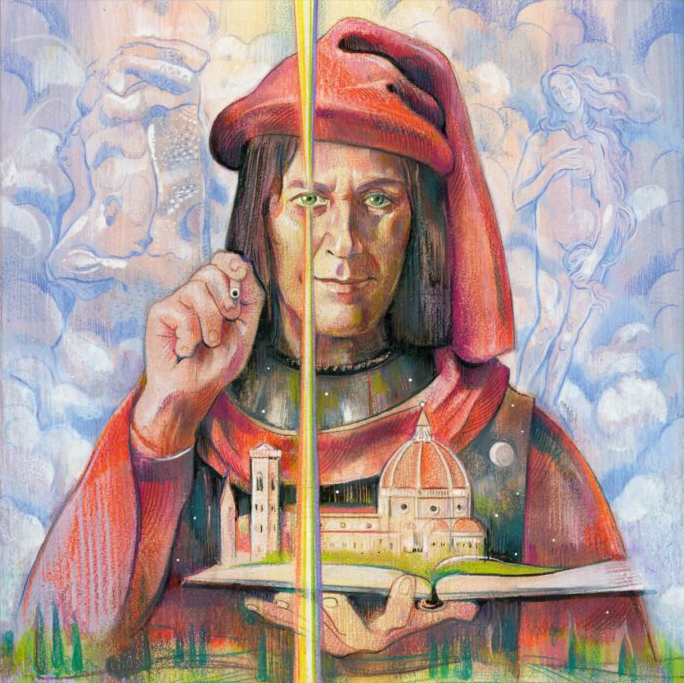
I would therefore like to devote these final lines to the illustrations of extraordinary beauty that Stephen Alcorn created for the feature on Florence and the Renaissance.
Something truly unique has occurred here: for the first time in years—indeed, in decades—the subject is so deeply intertwined with Alcorn’s personal and artistic journey that the creator of the cover has also become its subject. The result is a beautiful cover, and one that we are delighted to dedicate to all our readers.