

Kenny Scharf | Madrid, 29 September 2026 – 17 January 2027
At the Thyssen-Bornemisza Museum, Kenny Scharf’s colourful universe blurs the


When fairy tales did not promise that everything would turn out all right
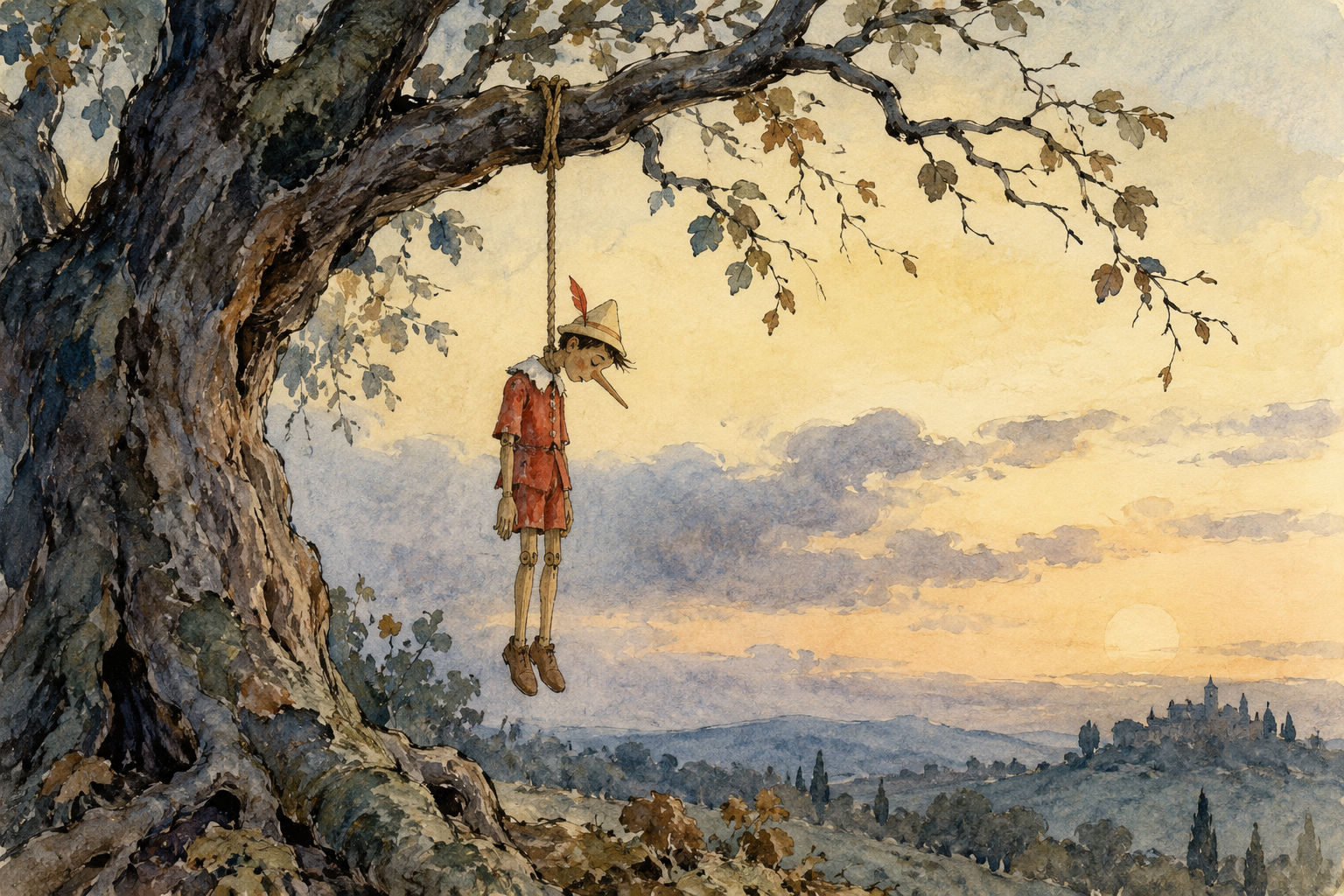
Pinocchio dies by hanging. The north wind shakes his body as it hangs from the Great Oak; the assassins have gone, and no one comes to save him. The puppet thinks of Geppetto, calls out to his father with his last breath, and lies motionless. The end. This is neither an apocryphal version nor a macabre parody: it is the ending Carlo Collodi published on 27 October 1881 in the newspaper for children.The story was still called The Story of a Puppet and ended with Chapter Fifteen. Only later, prompted in part by readers and the editors, did Collodi decide to continue it. Pinocchio survives, goes back to running about, lying and making mistakes. And one day he becomes a real boy. The episode already contains a small cultural revolution. Nineteenth-century children could read a story in which the protagonist died and no one saved him; but they could also protest, demand another ending and help, at least indirectly, to bring it about. Fear had a place in children’s literature, but its young readers did not necessarily accept it without resistance.
Long before Collodi, in 1697, Charles Perrault had published a Little Red Riding Hood in which the wolf devours the grandmother and then the girl. No huntsman intervenes, no one cuts open the beast’s belly, no one goes home. The story ends with a moral warning, addressed chiefly to young women, against seducers, who are all the more dangerous when they seem kind. The wolf is not merely a ferocious animal: he also embodies a social and sexual danger. In the version made famous by the Brothers Grimm, by contrast, the huntsman arrives, cuts open the wolf’s belly and frees them both. Fear remains, but the outcome changes: what seemed beyond repair can be put right.
Yet if we want to understand how fairy tales have changed, perhaps we should look not so much at wolves as at mothers. In the first edition of the Brothers Grimm’s Children’s and Household Tales, published in 1812, the woman who persecutes Snow White is not her stepmother. She is her mother. It is she who questions the mirror, discovers that her daughter has become more beautiful than she is, and orders the huntsman to kill her. And that is not all: she demands that the girl’s lungs and liver be brought to her. The huntsman spares Snow White and delivers the organs of an animal instead. The queen has them cooked and eats them, believing she is consuming her own daughter’s flesh. In the second edition, published in 1819, the Grimms make a decisive change. Snow White’s mother dies after giving birth to her, and the king takes another wife. It is this second woman who becomes the jealous, murderous queen. The planned murder and the gruesome meal remain, but the blame shifts: it belongs no longer to the mother, but to the stepmother.
We cannot attribute this change to any particular protest by readers or educationalists. We do know, however, that the Grimms repeatedly reworked their stories and, over successive editions, adapted them increasingly to an ideal of family reading. Replacing the mother with a stepmother is consistent with a growing idealisation of motherhood. A mother may die, be absent, leave her daughter exposed to the dangers of the world. But it becomes less and less acceptable for her to want to destroy the child herself. The detail is all the more significant because violence was by no means systematically removed from fairy tales. In Cinderella, the stepsisters mutilate their feet in order to fit into the slipper. And in the Grimms’ 1819 version, at the heroine’s wedding, two doves peck out their eyes. Doves, of all creatures: the very birds that had helped Cinderella, associated in Christian tradition with purity and the Holy Spirit, and in the modern imagination with peace and love. Here they become the agents of a terrible punishment. The contrast is striking. While Snow White’s mother is replaced by a stepmother, the punishment inflicted on Cinderella’s stepsisters becomes more savage. What we are witnessing, then, is not the progressive elimination of cruelty. Rather, it is its redistribution. Certain figures are no longer allowed to be wicked; others may remain wicked, and be punished without mercy. It would be a mistake, however, to imagine an ancient age of authentic, fierce, popular fairy tales, followed by their gradual falsification into comforting stories. Fairy tales almost never have a single, untainted original. They circulate orally, cross countries and languages, and change with those who tell them and those who listen. Perrault writes for the cultivated circles of Louis XIV’s France; the Grimms gather material from different sources, select it and modify it in successive editions. The versions we now regard as traditional are themselves the products of literary, moral and editorial intervention., le sorellastre si mutilano i piedi per riuscire a indossare la scarpetta. E nella versione dei Grimm del 1819, durante le nozze della protagonista, due colombe cavano loro gli occhi. Proprio le colombe: gli uccelli che avevano aiutato Cenerentola, creature associate nella tradizione cristiana alla purezza e allo Spirito Santo, e nell’immaginario moderno alla pace e all’amore. Qui diventano esecutrici di una punizione terribile. Il confronto è sorprendente. Mentre la madre di Biancaneve viene sostituita da una matrigna, la punizione delle sorellastre di Cenerentola diventa più feroce. Non assistiamo dunque a una progressiva eliminazione della crudeltà. Assistiamo piuttosto a una sua redistribuzione. Alcune figure vengono sottratte alla possibilità di essere malvagie; altre possono continuare a esserlo, e a essere punite senza misericordia. Sarebbe però sbagliato immaginare un’antica età delle fiabe autentiche, feroci e popolari, alla quale sarebbe seguita una progressiva falsificazione rassicurante. Le fiabe non possiedono quasi mai un originale unico e incontaminato. Circolano oralmente, attraversano paesi e lingue, cambiano con chi le racconta e con chi le ascolta. Perrault scrive per un ambiente colto della Francia di Luigi XIV; i Grimm raccolgono materiali di provenienza diversa, li selezionano e li modificano nelle successive edizioni. Le versioni che oggi consideriamo tradizionali sono già il risultato di interventi letterari, morali ed editoriali.
The question, then, is not when we began to censor fairy tales. It is why, at a certain point, we began to consider some of their terrors unsuitable for children. And why certain cruelties became unacceptable while others continued to serve a narrative and moral purpose. Part of the answer lies in the history of childhood. For centuries, children lived much closer than they do today to illness, death, food insecurity, work and domestic violence. This does not mean they were insensitive, or that adults loved them any less. It means that the material conditions of life made it less plausible to draw a sharp boundary between their world and that of adults. A forest really could be a place in which to get lost; a famine could make one more mouth to feed a matter of life and death; a hostile stepmother could embody recognisable family and inheritance conflicts. Fairy tales transformed these dangers into characters, journeys, encounters and ordeals. With the spread of schooling, paediatrics, new educational ideas and, gradually, a culture of children’s rights, expectations of stories intended for the young also changed. Increasingly, stories were expected to educate without hurting, to stir emotions without causing distress, to offer a recognisable place of safety at the end. The twentieth-century culture industry amplified this tendency, but did not invent it
Walt Disney becomes the most conspicuous symbol of this transformation. His 1937 Snow White and the Seven Dwarfs retains the murderous stepmother, the threatening forest, the poisoned apple and an apparent death. But it removes the final punishment the Grimms reserve for the queen: dancing to her death in red-hot iron shoes. In the film, the queen falls from a cliff as the dwarfs pursue her. Fear does not disappear, nor does the villain’s death: what changes is how they are represented. Animated cinema did not simply replace terror with tenderness. It rearranged the relationship between threat, suspense, relief and justice. Nor did this rearrangement proceed in a straight line. Children continue to seek out frightening stories, invent monsters and enjoy the thrill that comes from knowing they are safe. From ghost stories to contemporary fantasy fiction, horror for children has by no means vanished. It has acquired new conventions, new boundaries, new forms of negotiation between adults and children. Indeed, sometimes it is adults who underestimate how well the young can distinguish fear experienced through a story from a real threat. The fear in fairy tales had one characteristic worth considering today: it had a shape. Danger lived in the forest, had a wolf’s teeth, dwelt in a gingerbread house or wore the face of a jealous queen. It could be named, confronted and sometimes defeated. And when it was not defeated, as in Perrault’s Little Red Riding Hood, the story left an unsettling trace, a question without consolation. Today, many of the dangers hanging over childhood are harder to represent. The climate crisis, war watched through screens, threats spread across the digital world, adults’ anxieties: often they have no distinct face, no boundary beyond which one can safely return home. Perhaps that is also why we keep inventing monsters. At least a monster can be seen.
A paradox remains. We have tried to protect children from cruel stories just as the world has multiplied the opportunities for them to encounter frightening images and news, often without anyone to guide them through what they see. Traditional fairy tales, by contrast, were frequently a shared experience: someone told the story, someone listened, interrupted, asked questions, requested that a passage be repeated. What mattered was not only the content, but the relationship within which it was passed on. Perhaps, then, the point is not to give children back Snow White’s red-hot shoes or Pinocchio’s hanging. Nor is it to mourn a past in which cruelty was supposedly more honest. It is to ask what has changed in our relationship with fear if today we can regard a fairy tale told to a child as excessively cruel while accepting that the same child may encounter far more explicit depictions of violence on a screen. In fairy tales, you could be devoured by the wolf; in some video games, you can be the huntsman, the soldier, even the murderer. It is not necessarily more dangerous. But it is profoundly different.
At the Thyssen-Bornemisza Museum, Kenny Scharf’s colourful universe blurs the

Some people look at the world from unexpected perspectives, challenge

At Villa Bardini, 90 photographs tell the story of Asia,