
An Ideal Husband: Oscar Wilde unmasks the hidden face of respectability
Political intrigue, unconfessable secrets and sparkling social games: Ferdinando Bruni


From a problem about rabbits to the geometry of sunflowers, by way of Mediterranean Africa: how a sequence of numbers became one of the most celebrated images of mathematical beauty
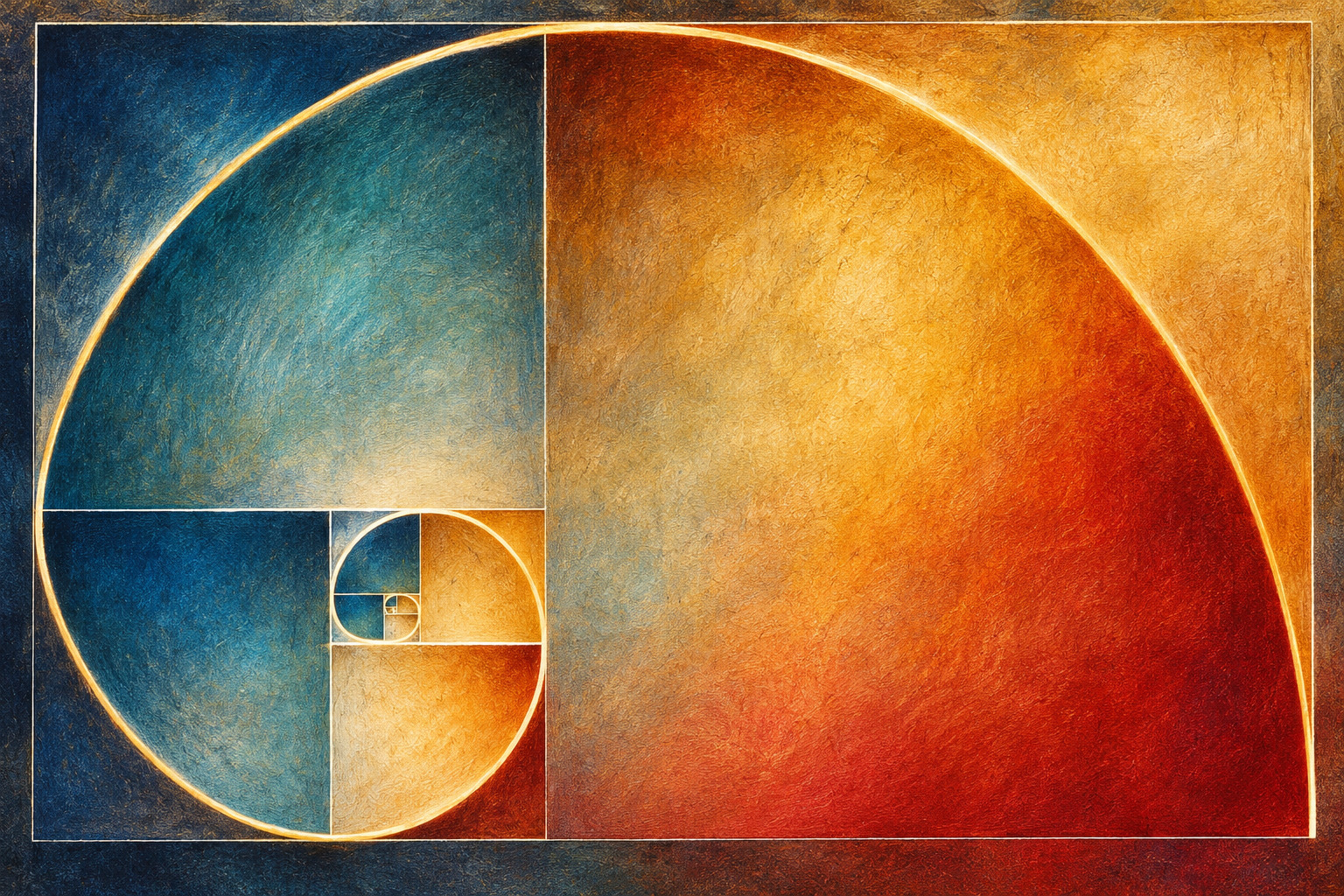
We all recognise it, even if we do not know exactly what it represents. A curved line winds through a succession of ever-larger squares, tracing a spiral of remarkable elegance. We encounter it in mathematics books, design manuals and photographs of shells and sunflowers, sometimes superimposed on Renaissance paintings or famous monuments. It is the Fibonacci spiral, one of geometry’s most enduring images. There is just one small problem: Fibonacci never drew it. Leonardo of Pisa, the mathematician who lived between the twelfth and thirteenth centuries and whose name is attached to the famous sequence, left no representation of that curve. The spiral formed by adjoining squares and drawing circular arcs inside them belongs to the later history of mathematical illustration. Nor is it exactly the same as the golden spiral, with which it is so often confused. But to understand how we arrived at this image, we must leave geometry behind for a moment and travel to the southern shores of the Mediterranean.
At the end of the twelfth century, Bugia, today’s Béjaïa on the Algerian coast, was an important Mediterranean trading centre. Merchants, goods, coins and knowledge arrived there from many different worlds. Among those who frequented the city was Guglielmo, Leonardo’s father, entrusted with representing the interests of Pisan merchants. Leonardo joined him while still young and received a mathematical education that would change his life. He encountered the Hindu-Arabic numeral system, based on ten digits, including zero, and on positional notation. Today the system seems self-evident. But imagine trying to perform a complicated multiplication using Roman numerals alone. The difference immediately becomes clear. Leonardo grasped the extraordinary effectiveness of these methods of calculation. He travelled, studied other mathematical traditions and, in 1202, published the Liber abaci, a work that would make a decisive contribution to the spread of Hindu-Arabic arithmetic in Latin Europe. European mathematics, then, did not emerge from an exclusive conversation with itself. A crucial part of its development passed through ports, schools, markets and translations. Fibonacci’s story is also that of a Mediterranean in which knowledge travelled alongside goods.
The Liber abaci contains a seemingly modest exercise. Imagine a pair of rabbits that, after an initial period of maturation, begin to reproduce. Each new pair follows the same cycle, and none of the animals dies. How many pairs will there be after a given number of months? The problem leads to a sequence in which each term is the sum of the preceding two: 1, 1, 2, 3, 5, 8, 13, 21, 34, 55, 89… The rule is so simple that it might seem almost trivial. Yet it generates a mathematical structure of extraordinary richness. Leonardo was not the first to encounter sequences of this kind. Centuries earlier, Indian mathematicians had studied similar relationships while addressing problems in poetic metre, particularly the counting of possible combinations of short and long syllables. A problem about verse and a problem about rabbits can therefore lead to the same numerical structure. It is one of mathematics’ most beautiful surprises: apparently unrelated situations can share the same underlying organisation.
Now take a series of squares. The first has a side of length 1, the second also 1, the third 2, the fourth 3, followed by 5, 8, 13 and so on. Arranging them in an orderly pattern gives us progressively larger rectangles. Draw a quarter-circle in each square and the arcs join to form a continuous curve: the celebrated Fibonacci spiral. Its beauty is immediate. The curve seems to grow while preserving an inner harmony, as though each new movement retained the memory of those before it. Yet the figure conceals an important distinction. The spiral made of circular arcs is an approximation of the golden spiral, a particular logarithmic spiral. The latter grows according to a constant proportion and preserves its shape as it expands. The connection comes from a property of the sequence: dividing one term by the preceding term produces a result that gradually approaches an irrational number, approximately 1.618, known as the golden ratio. The relationship is real. The claim that the two spirals are exactly identical is not. This need not disappoint us. Rather, it invites us to distinguish mathematical precision from the freedom of the images through which we try to represent it.
And now we find ourselves before a sunflower. Look closely at the arrangement of its tiny florets, which will produce the seeds, and two families of spirals become visible: some appear to wind clockwise, others anticlockwise. Count them, and we often find two consecutive Fibonacci numbers: 34 and 55, or 55 and 89. Similar structures appear in pine cones, pineapples and the arrangement of leaves on many plants. Why? The answer does not require us to attribute a mysterious knowledge of arithmetic to plants. It lies in the processes through which organisms grow and arrange their elements in space. In many models of plant growth, each new element appears rotated relative to the preceding one by an angle close to 137.5 degrees, the so-called golden angle. This arrangement tends to distribute elements without systematically overlapping them. In leaves, it can help limit mutual shading; in flower heads, it can organise the available space efficiently. The spirals we recognise are a geometric consequence of these arrangements. Of course, not all plants follow the same pattern, and not every sunflower displays counts that fit the sequence perfectly. Nature is far more varied than the diagrams we use to describe it. Yet the phenomenon remains astonishing: a mathematical rule studied for entirely different reasons can help us understand the forms of biological growth.
At this point another story begins, less mathematical and perhaps even more human. The Fibonacci sequence and the golden ratio have acquired a privileged place in the contemporary imagination. They are said to govern the proportions of the human body, ancient architecture, Renaissance painting, shells, hurricanes and even galaxies. Some geometric relationships can be documented. Many others arise from arbitrary overlays, selective measurements or purely visual resemblances. A spiral drawn over a photograph may seem like irresistible proof. But if we can move, rotate and resize it until it matches whatever we want, we have not necessarily discovered a law: we may simply have produced a persuasive illustration. This is the danger of turning a mathematical property into a universal explanation of beauty. And yet we need not imagine that every shell conceals the golden ratio in order to admire the geometry of shells. Nor must we believe that every great artist secretly applied the same proportion in order to recognise the complexity of their work. Mathematics loses nothing when we stop treating it as a religion. On the contrary, it becomes more interesting. For the true wonder lies not in finding the same number everywhere, but in discovering that similar structures can emerge from profoundly different processes: combinations of poetic rhythms, the idealised reproduction of an animal population, the growth of a flower head, the construction of a geometric figure.
Finally, let us return to our spiral. Leonardo of Pisa never drew it. He could not have imagined that, many centuries later, the sequence associated with his name would become one of the most reproduced images in mathematics. And perhaps that is the most fascinating part of the story. Knowledge born of encounters between different cultures, carried through Indian poetry, the arithmetic of the Islamic world and a book written by a Pisan mathematician, continues to raise questions Leonardo himself never asked. The spiral that wasn’t there has become the symbol of something that truly exists: mathematics’ power to reveal unexpected relationships between seemingly distant phenomena. Nature does not need to know Fibonacci to surprise us with its numbers. We are the ones who need Fibonacci to learn how to recognise them.
Political intrigue, unconfessable secrets and sparkling social games: Ferdinando Bruni
When success prepares the conditions for its own undoing In

At Museo della Permanente, 100 award-winning photographs celebrate the beauty