

Man Ray | Rovigo, 13 November 2026 – 31 January 2027
At Palazzo Roverella, a journey into the visionary world of

On Halloween night, the dead return. Or so we like to tell ourselves. But if we were to trace the story back to Samhain, the Gaelic festival to which Halloween owes an important part of its history, we might encounter a surprise: the most unsettling visitors on that night were not necessarily dead. And perhaps the boundary that opened did not even separate life from death. It separated two worlds, both inhabited.
Today Halloween is instantly recognisable: illuminated pumpkins, plastic skeletons, costumes, children knocking on doors demanding sweets. Its imagery is so pervasive that it seems both immemorial and irredeemably contemporary. Yet behind this cheerful industry of fear lies a less straightforward history than the familiar accounts of its origins suggest. There is no single festival that has passed unchanged through the millennia, merely changing its costume. There are traditions that meet, overlap, fall into oblivion and are reinvented. Above all, there is a question that survives their transformations: what happens when a boundary thought to be impassable ceases, for one night, to be so?
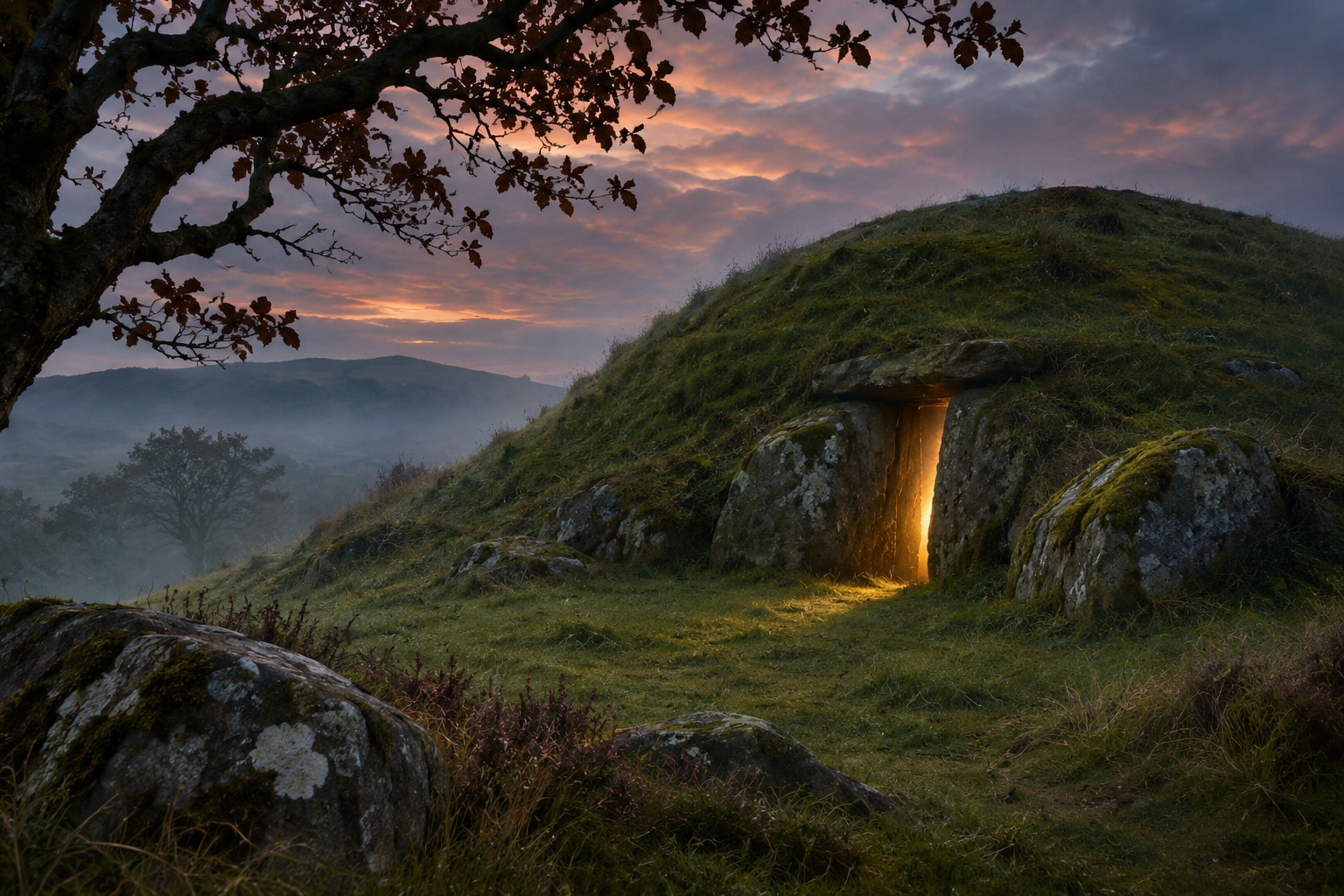
In the ancient Irish tradition, Samhain marked the passage from the bright season to the dark. It was the moment when summer ended and winter began, when work in the fields slowed, herds were brought back to shelter and communities prepared for the hardest months. A concrete, material divide before it was a symbolic one. It is hardly surprising that assemblies, feasts and extraordinary tales gathered around this seasonal threshold. In medieval Irish literature, Samhain is often the time when impossible things happen. Hills open, beings from another world cross the human landscape, unexpected encounters alter human destinies. In one tale, The Adventure of Nera, its protagonist becomes involved in an experience that takes him into the Otherworld on Samhain night itself. Ordinary time loses its solidity: what seems familiar may prove deceptive, what appeared distant becomes accessible.
It is important, however, to remember that these tales were written down in the Christian era. They are neither records of druidic ceremonies nor direct accounts of prehistoric rituals. They preserve older narrative material, but also rework it. They allow us to glimpse the medieval Irish imagination and some of its probable inheritances, not to reconstruct a pagan festival gesture by gesture. And, crucially, not all the beings who cross the boundary are dead. Samhain, after all, did not invent the Otherworld. The Irish tales in which this night takes on an extraordinary significance belong to a culture already familiar with a vast repertoire of non-human presences, places inhabited by invisible beings, hills concealing dwellings and kingdoms beyond ordinary sight. The aos sí, the people of the hills, are among the best-known expressions of this imaginary world, which we know through medieval sources and later folklore. It would be rash to attribute an identity unchanged since pre-Christian times to all these figures; it would be equally reductive to regard them as an invention of the festival. Rather, Samhain provides a privileged narrative occasion for a supernatural world that already possesses a geography of its own. The night does not create its inhabitants: the night makes it possible to encounter them.
We might be tempted to recognise elemental spirits in these presences, creatures associated with the forces of nature. But here too we must distinguish between periods and traditions. The classification of elementals into gnomes, undines, sylphs and salamanders belongs chiefly to the esoteric culture of early modern Europe, in which Paracelsus played a decisive role. The beings of the Irish Otherworld do not follow this scheme. Yet they share with it a conception of landscape that modernity has progressively abandoned: nature is not an empty setting but a world inhabited by presences that do not belong to the human species. Moreover, in Irish mythology the Otherworld does not necessarily coincide with the realm of the dead. Its inhabitants have dwellings, powers, intentions, sometimes genealogies and rulers. They may be benevolent or dangerous. They are not simply souls awaiting an otherworldly destination. They are other beings, belonging to an adjacent reality that is normally inaccessible.
The distinction is decisive. Samhain then becomes something more interesting than a mere commemoration of the dead. It is the moment when the world’s order may waver, when the separation between what we know and what we do not know appears provisional. But we have not always told this story in this way. For much of the modern era, Samhain has been presented as the Celtic New Year and the Celts’ great festival of the dead. This image entered popular books, neopagan reconstructions and the collective imagination until it became almost unquestionable. Yet the evidence is less solid than the idea is popular. The British historian Ronald Hutton has reconstructed the role played, between the nineteenth and early twentieth centuries, by the scholars John Rhys and James Frazer in spreading this interpretation. That Samhain marked a fundamental turning point in the year is well documented. That it was everywhere the Celtic New Year, or a ceremony universally dedicated to ancestors, is not. This does not mean that the dead were absent from beliefs associated with that night. In more recent Irish folklore, the dead do indeed visit, doors are left open and food is prepared for invisible guests. Rather, it means that we cannot automatically project these testimonies back across many centuries, as though a custom recorded in the nineteenth century were a faithful photograph of an Iron Age rite. The history of Halloween thus begins to grow more complicated. And it is precisely this complexity that makes it fascinating.
The Christian calendar, too, bears the traces of a history that is anything but straightforward. In 609 or 610, when Pope Boniface IV consecrated the Pantheon to the Virgin Mary and all the martyrs, the feast was celebrated on 13 May. The first of November became established only later, between the eighth and ninth centuries, through initiatives in Rome and the spread of the feast throughout the Carolingian world. The history of 2 November, devoted to the commemoration of all the faithful departed, is different again: its establishment owes much to the abbey of Cluny and to the initiative of Abbot Odilo, between the tenth and eleventh centuries. Two adjacent dates, then, but two different paths, which gradually converged into a single season of remembrance. That the Church may have wished to occupy a ritual space already important to pagan populations is a plausible hypothesis; that it simply turned Samhain into All Saints’ Day is a conclusion the sources do not warrant. The coincidence remains suggestive, and its historical explanation far from settled. The eve of All Saints’ Day, All Hallows’ Eve, would give Halloween its name. Popular customs in the British Isles continued to intertwine with the religious calendar without losing all their independence.
Within this interweaving, the meaning of nocturnal visitors also changes. Alongside beings from the Otherworld come the souls of the departed, family memory, prayers and practices of intercession for the dead. The cosmic threshold becomes an emotional threshold as well. It is no longer only a matter of protecting oneself against unknown presences: it is a matter of maintaining a relationship with people once known, loved and lost. The dead person is not only someone who inspires fear. It is also someone who is missed. Centuries later, Irish and Scottish traditions cross the Atlantic with emigrants. Costumes, divination games, lanterns carved from vegetables and visits from house to house enter a different social environment. In the United States, their materials, scale and meanings change. Carved turnips give way to pumpkins, larger and more spectacular; the festival gradually becomes a communal, child-centred, commercial occasion. Eventually it returns to Europe, transformed, as though it were an entirely American novelty.
It is one of the most successful ironies of cultural history: a tradition sets off, crosses an ocean, reinvents itself and returns to its places of origin, where it is sometimes accused of being foreign. But it would be too easy to conclude that Halloween has simply lost its meaning. Commercialisation has certainly produced an extraordinary quantity of useless objects; it has not, however, erased the festival’s symbolic core. Even as a game, Halloween continues to stage the intrusion of the strange into everyday life. Houses become places to visit in disguise, children impersonate monsters, the living take on the appearance of the dead for a few hours. Fear is domesticated, made ridiculous, handed out in little sweets. It is a thoroughly modern way of negotiating with the unknown. And yet something resists this domestication. Samhain night belonged to a world in which landscape was not merely physical space. A hill might conceal a people, a path might lead elsewhere, a date on the calendar might change the rules of encounter. Modernity has progressively stripped the land of these invisible inhabitants, but it has not eliminated the desire to imagine them. Indeed, even as it multiplied explanations of the world, it continued to invent occasions for suspending them. Perhaps this is the deepest continuity between Samhain and Halloween. Not an unchanged rite, not a secret doctrine surviving for two thousand years, but the persistence of a question: are we really certain that the world ends where our knowledge ends?
There is another threshold, harder to cross: the one between presence and absence. Traditions of returning dead, Christian commemorations, visits from ancestors and even the ghosts of modern stories express, in different forms, a very human difficulty: accepting that those who once inhabited our world have disappeared from it completely. The dead do not necessarily return because someone believes they have seen them. They return because they continue to inhabit places, words, gestures and memories. They are absent, but not entirely. Perhaps, then, the history and counterhistory of Halloween lead us to a small reversal. We searched for the origins of a festival of the dead and encountered a festival of thresholds. We imagined ancestors emerging from their graves and found beings who, according to the tales, had never been human. We sought a tradition that had remained identical to itself and discovered a long succession of transformations. And we returned to where we began: a night when what is distant may draw near. We do not know what words the ancient inhabitants of Ireland spoke as winter approached. But we know they left their descendants tales in which the visible world did not exhaust all that might exist. Halloween has changed its face many times. That question, however, has not yet stopped knocking at the door.
At Palazzo Roverella, a journey into the visionary world of
Lake Geneva, Wisconsin, 1968. In a small town of just
When fairy tales did not promise that everything would turn